30 Jun 2006

Disaster!!!!

No new birds for the list

Yesterday morning my lovely camera fell off the kitchen table and my 100mm lens was trashed and my camera (Canon Eos 10D)
is not working properly. It takes photos but is massively over exposing so they have gone off to Calumet to get a quote for repair.God I hope it isnt too expensive. So I will probably be posting either old photos or phonescoped versions.

So here are a few bird photos I took in New Zealand and Australia last year.

Red Billed Gull

North Island Kaka

Northern Royal Albatross

Silvereye

Kookaburra

Masked Lapwing

Chestnut-Breasted Mannikin

24 Jun 2006

Orchids and Storm Petrel

142. Storm Petrel

I went out to Killard this afternoon with Pickle, my working cocker spaniel. I have not been out here for over a week and the difference in growth is amazing. Also the orchids are now in full bloom. It really is a magical spot in the summer with all the wild flowers.In early May, the blues of spring squill and bluebells appear. Through June, yellow flowers of bulbous buttercup, kidney vetch and wild pansies predominate. In July, restharrow, centaury and pyramidal orchids change the scene to pink while in August the rich purples of knapweed, thyme and field scabious complete the picture. Many of the plants found are uncommon or rare in Ulster. Thousands of orchids flowering in late June produce a display unequalled in the province.

Well as to Birds there were loads of Sand martins flying over the fields, a Whitethroat, a few Stonechats and many Skylarks and Meadow pipits feeding their nearly adult young. Infact the sound of the Larks was almost deafening. When I got down onto the beach there was not many birds around apart from a heron and a few oystercatchers. So I decided to look out to sea with the scope. There was a sea mist starting about a mile offshore which I have found tends to bring the pelagic birds closer to the coast. I could see a few Gannets both mature and immature flying by as well as Manx Shearwaters, Guillemots and then for my first time from the shore I saw a Storm Petrel
fluttering over the water black all over with its very distinct white rump.It always gives me a buzz to see a new bird especially a pelagic as it means that I will not have to go out to sea to see them (I usually get very seasick and wouldnt enjoy a pelagic bird trip at all)

15 Jun 2006

The Heron and the Eel and another for the list.

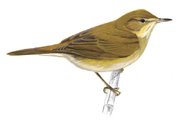
141. Reed Warbler

I stopped off last night at the Quoile Hide and regrettably due to the lack of management the area in front of the hide the reeds are growing up so fast that it is becoming very difficult to see much. However I did see this Heron dart forward and come up with an eel that was at least 18 inches long. Well over the next ten minutes I watched the eel being swallowed alive and writhing around in the gullet of the Heron before popping back up and escaping before again being grabbed and banged around. The eel was entwining itself completely round the Heron's bill and again slipped from the Heron's grasp. Yet again the heron ran forward and grabbed it. It appeared to be trying to serrate it up and down its bill. At this stage there was a certain amount of blood flowing from the eel, who was determined not to give up the struggle. It was swallowed again and yet again it came back up and slipped out of the heron's mouth. Sadly this time the heron stabbed it right in the head and it was swallowed with no more defence. After which the heron proceeded to rub its beak back and forwards against the reeds, which I assume was to get rid of the slime. Nature is cruel. I didnt have a camera with me but here is another picture of a Heron with unexpected prey. See HERE and after it drowns it See Here

At lunchtime today I popped down to the RSPB Hide on Belfast Harbour, fortunately my new job means that I am only 5 mins drive away. Anthony the warden was there with his brother and we went to see if there were any Reed Warblers. Anthony is very good on identifying birds by sound. I have to admit I have difficulty in determining the difference between Sedge Warbler and Reed Warbler .Anthony then phished the birds.

What is phishing?

Phishing refers to a group of noises that birders make in the hope of attracting birds; some noises work better than others. Time of day, time of year, weather, ambient noise, crowds and even too much pishing can affect the success of the procedure. True phishing (various silibant noises made by forming "s" or "sh" sounds with the tongue); the theory is that pishing throws out an array of frequencies taken to be alarm calls. These alarm calls are recognized mostly by Passerines. I think most people are of the view that a limited use of pishing to attract shy birds in a setting where the bird will not be repeatedly bothered -- and where you are not interfering with nesting of or brooding course -- is not likely to be very stressful to the bird and hence is acceptable. Views are more mixed on tapes, with some people finding it both unwarranted and unnecessary and others thinking it perfectly acceptable if used cautiously. I am of the latter view.

Anyway it was successful and this Reed Warbler appeared ;another for my year list :-)

9 Jun 2006

My first ever Curlew Sandpiper and Phonescoping.

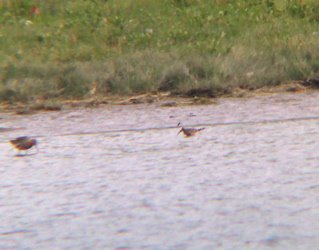
139. Curlew Sandpiper.

There are times when one is doing a year list you think am I going to see any more birds this year. I hadnt seen anything for three weeks and then I saw the Spotted Flycatcher and yesterday I was in the Castle Island Hide on the Quoile after work chatting away to a couple who had come by motor boat from the Isle of Man. They were telling me about the Choughs and some of the seabirds they had seen on the way over. I had left my scope at home and only had my binoculars which are Leica 10 by 25's. However even though I could see waders on the far shore I couldnt clearly identify them apart from the Black Tailed Godwit. Then another couple of guys came in , one of whom was Dennis Weir, who I have subsequently heard is one of the best Northern Ireland Birders He had just come back from a birding trip in Venezuela on which one of his best friends Willie McDowell, another extremely well known NI birder,had died in his sleep.(I think when my time comes that is how I would like to go). Dennis's friend suddenly said I think thats a Curlew Sandpiper on the far shore and Dennis confirmed it. They then generously let myself and the couple from the Isle of Man look through their scope. A lifer for me.I decided to go home and get my scope and try out phonescoping, that is to say using the camera in my mobile phone to take a photo using the telescope as a long lens. As it was well out of reach of my 100-400mm lens . An artform that will have to be improved on as it is not easy.

6 Jun 2006

Finally after three weeks a new bird for my year list.

138. Spotted Flycatcher

I have been very poor at writing my blog recently. I have just started a new job where I will be providing the food for a chain of seven cafes in Belfast, therefore alot of my time has been taken up setting up the kitchen. Tonight I went for a walk with my wife in Castle Ward (A National Trust estate nearby, where we lived for twelve years) It was a lovely evening and was made even better when within fifty yards of parking the car I saw the Spotted Flycatcher and its discreetly streaked breast. As I was watching through my binoculars my wife ,as usual, continued walking towards it and it flew off. These birds are on the Red List which means that they are Globally threatened, their Historical population declined in the UK during 1800-1995 and there has been
rapid (> or =50%) decline in UK breeding population over last 25 years and rapid (> or =50%) contraction of UK breeding range over last 25 years.
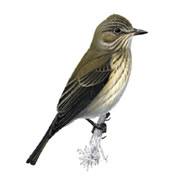
It is a summer visitor here and spends its winters in Africa. Now I know where to find it I will have to go back with my camera to see if I can get any shots.

Talking of Bird Photography I had a link from this blog to my list of bird photographers of the world which google has decided in its infinite wisdom is a spam site and have blocked me from posting to it or editing it so when I have the time I am going to set up a website dedicated to bird photography. I have registered the site www.peregrinesbirdphotographers.com and once my new job is more underway I will work on it. However for the time being I am adding the links to the side bar in this blog.

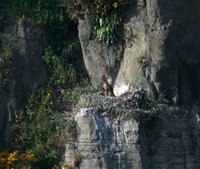
I have also been visiting a peregrines nest site, well I have been watching them across a quarry at Scrabo Tower, two adults and four nearly fully fledged juveniles. In this photo even though it is hard to make out there is the female and four chicks and the male was sitting on a rock 20 feet further up the quarry face. I have been to this site a number of times and what amazes me is the amount of woodpigeons that run the gauntlet of flying in front of the nest. You would have thought they would have the area designated as a no fly zone!
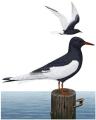
I am hoping for a call in the morning to say that a White Winged Tern that was spotted at RSPB Belfast Harbour Reserve this evening is still around and that I can go and see it before work tommorrow. It is a rare vagrant and there are 10-40 records annually in the UK and Ireland.The White-winged Tern, or White-winged Black Tern, Chlidonias leucopterus, is a small tern.
Adult birds in summer have short red legs and a short black bill, a black head, neck and belly, very dark grey back, with a white rump and light grey (almost white) tail. The wings, as the name implies, are mainly white. In non-breeding plumage, most of the black is replaced by white or pale grey.

Their breeding habitat is freshwater marshes across from southeast Europe to central Asia. They usually nest either on floating vegetation in a marsh or on the ground very close to water, laying 2-4 eggs in a nest built of small reed stems and other vegetation. In winter, they migrate to Africa, southern Asia and Australia. It is a scarce vagrant in North America, mainly on the Atlantic coast, but a few records on the Pacific coast and inland in the Great Lakes area.
Like the other "marsh" terns (Chlidonias), and unlike the "white" (Sterna) terns, these birds do not dive for fish, but fly slowly over the water to surface-pick items on the surface and catch insects in flight. They mainly eat insects and small fish.

The name 'White-winged Tern' is the standard in most English-speaking countries; in Britain, this name is also the one used by the formal ornithological recording authorities, but the older alternative 'White-winged Black Tern' is still frequent in popular use.

27 May 2006

Its been a quiet week and stabbed by a heron!

Still my year list does not get any bigger. As afar as birding I have had a very quiet week. A couple of days ago I was on my way to walk my dog when I came accross a young Grey Heron on a busy road , I assume it had fallen from its nest as there is a heronry above the road. So I pulled up and went to move it which it did not appreciate at all. It was squawking and squawking at me and caught me a glancing blow on the back of my hand. I caught it around the middle and lifted it over a wall where I felt it would be safer. It was amazing how light it was for what looks like quite a big bird. I hope it wasn't predated over night.

On Thursday Carel Brest van Kempen, the Nature artist and blogger at Rigor Vitae posted the latest I and the Bird ina cartoon style. Go visit his I and the Bird #24 for the best posts from recent bird blogging. His cartoon of the Montagu's Harrier which I wrote about earlier is very clever.

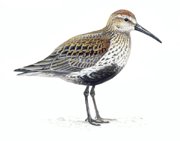
This morning I was on duty at the RSPB Bird Hide on Belfast Harbour and there was little around until the tide turned at which point quite alot of gulls appeared. The Common Terns and Arctic Terns were congregating on their islands always a pretty site. Then out of the blue a peregrine dived and missed its prey to be followed a few minutes later by another successfull dive catching a poor unfortunate Dunlin .


This painting is by Martin Ridley his Wildlife Art Portfolio is here

21 May 2006

Bird Photography Websites and very wet here in Northern Ireland

Sometimes I despair on two occasions in the last three days I have written my latest blog to erase it by mistake without saving it.
Third time Lucky I hope.

I have been working very hard on my links site for Bird Photographers.I have been trawling the web for sites and then copying and pasting them into a database. I have well over three hundred now and am dividing them up by country. In time I will review each site. I would like to build the site into a reference site for other Bird Photographers to go to, to look for other peoples work. For now here are a couple that are well worth having a look at Alan Murphy from the USA and Markus Varesvuo from Finland.

Well my Bird List is not getting any longer I am at 137 and at the beginning of the year I had hoped to get to 200. I have my doubts whether I will succeed unless I start driving longer distances within Ireland. I could of course go and visit my sister in Scotland at her Cottage/B and B. She has nesting Ospreys within five miles and is only an hour or mores drive from The Rspb site at Lough Garten in Abernethy where I could possibly see Crested Tit,Scottish Crossbill and Capercaille. Or even go and stay in Suffolk with my brother in law who isnt far from Minsmere where I could increase my list considerably Bittern, Avocet etc. I was volunteering today at RSPB Belfast Harbour and I met a guy called Ivan who happenned to be a boyfriend of a friend of a very good friend of mine;its a small world. Ivan reckoned I would probably have difficulty getting to 200 especially as I had dipped at least five or six birds recently. He's probably right.

In the last week we have had alot of rain for Northern Ireland especially in May.(Depressing) In the past I reckon May is the best month of the year in Ireland. Now where I do alot of my birding is at the Castle Island Hide on the Quoile Pondage and in the last week the water level has risen to the highest Ive seen it and in doing so has destroyed
two Gt Crested Grebe nests and two Coots nests and those are the ones I have spotted. The Dept of Environment and Heritage Service(DoE) , in my opinion , run the reserve very poorly when it comes to the bird breeding season. The Quoile Pondage has a barrage at the end of it which is controlled by sluices. All it would take is the DoE and the Water service to liase and keep the water at a certain level. Thats Government departments for you nobody with any balls to make decisions until its too late. it would also probably take two years of meetings to make a decision.

Here's to better weather next week.

17 May 2006

House Martin evicted by House Sparrow (Story has a happy ending)

136. Carrion Crow
137. Arctic Tern


On April 21st I wrote in my blog here that I was really happy that our resident housemartin had returned from Africa. Well within the week a House Sparrow had taken over the nest. Infact every evening I reckoned that the Sparrow and Housemartins were sharing the nest but then it became obvious that the Housemartins had been usurped, much to my annoyance. I was saddened that they had come all this way to be evicted. Subsequently I have seen housemartins around but not as much.I thought that they must have moved to the farm that is adjacent to our house. Well I was mowing the lawn yesterday at the back of the house and I observed a Housemartin fly up into the eaves above an outdoor light and there was a new nest. It made my day. It is amazing with birding how little things like that absolutely make your day.

The weather today has been wet and miserable and as I was going to Belfast I thought I well I will pop into the hide on Belfast Harbour Estate. There wasnt alot to see today compounded by the fact that when I tried to photograph some Arctic Terns ( The first I had seen this year) I remembered I had left the battery in the charger at home. Doh! Anthony McGeehan did a very good job of explaining the differences between the Common and Arctic Terns to David (Todays Volunteer at the hide) and myself. There is no doubt in my mind that to watch birds with a very experienced birder can only improve ones own bird recognition, especially as in Anthony's case the knowledge is passed on so expertly. (This blog will soon be called The Anthony McGeehan Fan Club Blog!!)

Sometimes on Bird Forum there are really interesting threads and today I found a link to this bird identification quiz on a Bavarian website , which is in many languages including english. I am hooked. Try it if you know your European birds.

15 May 2006

I dipped a Little Ring Plover but I did see an amazing display by a Peregrine.

135. Red Legged Partridge.

Well I looked out of my living room window and there were two hares.The Irish hare only occurs in Ireland – it is a sub-species of the mountain hare which occurs in the rest of the UK. The Irish hare is a native species with a russet brown coat, long ears with black tips and eyes set high in the head, which gives it a wide field of view for evading predators. Irish hares occur in a wide range of habitats, including lowland raised bogs, blanket bog, grasslands and sand dunes. In my case grassland. This is the first time this year I have seen them in the field. As I was looking at them with my lovely lightweight Leica 10 *25's I noticed two Red Legged Partridge walking directly behind them, neither seemed concerned with each other.

On flightline there was a message that a little ringed plover had been seen at the RSPB Belfast Harbour Reserve so I popped upto Belfast for 11'o'clock. The Hide was closed until 1.00pm and as there were quite a few birders hanging around I opened up and stayed until the afternoon volunteer arrived. I am very glad I did. We couldnt find the Little Ringed Plover but were entertained massively by a Peregrine diving into the flocks of Common Terns, Black Tailed Godwit and Dunlin. It caused absolute mayhem. It was unsuccessful and would fly quite high over the reserve before diving back down again. This carried on for five minutes and was very spectacular. Meanwhile the godwits were flying in circles but increasing their altitude to get out of the diving range.
The Peregrine photos are a bit too far for my 400mm lens and I had great difficulty tracking it. It then flew of towards The Harland and Wolff Giant cranes.

I met a few new birders to me a couple of Ian's and George Gordon who runs Flightline so efficiently. Georgetold me about the differences in spotting a Bar Tailed Godwit to a Blacktail Godwit. I saw a bartail at the far side of the reserve which I couldnt really identify apart from the fact it looked like a godwit. One of the main things to look out for is the tibia length. It is shorter in a bartail as opposed to a blacktail . Now to demonstrate my observation skills. After I left Belfast I stopped in the Castle Island Hide on the way home where there was another birder who mentioned Black Tailed Godwit on the far side of the pondage. So I regaled him with the differences of the two types of Godwit that I had just learnt and he said " I know I told you in the hide in Belfast"!!!!!! Well George it was nice to meet you and I will try to remember you the next time. Just make sure you are wearing the blue hat.

13 May 2006

A sad tale about Ringed Plover and "I and the Bird"

134. Garganey Anas Querquedula


To start with I saw two male Garganey this afternoon at the Quoile Castle Island Hide. They are fairly scarce and this was the first time I have seen them in the wild. On Flightline ( 02891 467408 ) The Northern Ireland Birdwatchers Association's Rare Bird Alert there had been a number of sightings in the last 48 hours but none at the Quoile. Flightline works very well: You ring and listen to an answering machine with the latest sightings and then if you have a sighting you leave a message afterwards.


I have been out to Killard with the dog nearly everyday recently and was glad to come across a Ringed Plover nest with four eggs in it on wednesday. They are incredibly difficult to see and I made a mental note of its relation to a bit of flotsam.It was situated just above the high tide line on the beach. Well the following day I went out and there were two eggs left in the nest Can you see them? I doubt it. Here they are at 10 times magnification. Well I went out again today and sadly there are footprints absolutely straight through the nest and the remains of the eggs. It doesnt look as though the two foot tracks stopped or even noticed what they had done!!
I do think that the Dept of Environment and Heritage Service ought to cordon off this small section of the beach during the breeding season to give these birds a helping hand as Killard is designated as a ASSI (Area of Special Scientific Interest)


This week I am part of the I and the Bird Blog Carnival
being hosted by Bird DC . For those of you that are not aware what a blog carnival is. Here is a description courtesy of "I and the Bird".

What is a carnival?

A Carnival is a periodic presentation of excellent blog writing, selected and submitted by the authors themselves. The first carnival, Carnival of the Vanities, sought to showcase posts that bloggers felt were their very best, which is why such a collection can be called a vanity. Subsequent carnivals have developed in the same spirit, but are usually focused on a particular theme. The one that has influenced me the most has been the Tangled Bank, a carnival for science, medicine, and natural history bloggers. Other successful examples include Carnival of the Capitalists (business, marketing, finance, economics, capitalism), The Skeptic’s Circle (critical thought, myth debunking), Grand Rounds (medical blogging), and Philosopher’s Carnival (philosophy, natch.) A comprehensive list of current carnivals can be found at Blog Carnival, Conservative Cat, and the TTLB ÜberCarnival.

One of the defining traits of a carnival is that the responsibility (some call it honor) of being the host rotates. Each installment is edited by a different blogger and hosted on that person’s blog. Though hosting a carnival can be a lot of work, most bloggers find the experience quite satisfying. The potentially dramatic increase in traffic doesn’t hurt either.

What makes I and the Bird different from other carnivals?
At long last, bird bloggers have a carnival to call our very own. I and the Bird is a compendium of blog writing about birds, specifically some form of bird watching.

When is the carnival?
I and the Bird is published every other Thursday. If there wasn't a new one last Thursday, expect one this Thursday. Of course, we have contributors from all over the world, so time differences may shift the publishing time significantly.

Still working on the Bird Photography Link. Click on under construction and it will take you to the basic site.