10 May 2010

Killard Nature Reserve in May

I love Killard Nature Reserve. Below is an aerial photograph taken by Photographer Mike Hartwell of Northern-Eye. It shows Killard half way between high and low tide it also shows the Strangford Narrows going up past Portaferry and Strangford into Strangford Lough itself.


Killard is the peninsula leading out into the sea. I visit it all year round sun, rain, wind or snow. Well snow is pretty rare. But it is this time of year I look forward to the most. All the flowers start to appear again It is usually the primroses followed by the heath dog violets, then the spring squill and then the orchids.

Primroses


Spring Squill


Heath Dog Violet


Thrift


As well as the flowers there are also the returning migrants either passing through such as the Whimbrel, Wheatear and Dunlin, or staying to breed like the Whitethroats. The air is filled with the song of Skylark,The Whimbrel are calling, The Whitethroat sing in the hedgerows. All in all a great time of year.


Whitethroat


There seem to be less Stonechats around, which seems to be the general conclusion throughout Ireland probably due to the severe winter. There is one pair of which the male can be photographed fairly easily.


Male Stonechat


Some days you can see lots of Wheatear others only one or two. I find them fairly hard to get close to.


Wheatear


Over the last few months one of the things I had been noticing was the large amount of Brown-Lipped and White-Lipped Snail shells broken at the base of rocks. It wasn't until I bumped into Brian Black (UTV Environment Correspondent) that he asked me if I had ever seen any thrushes out there as he had wanted to film them. I had to say I hadn,t. I occasionally see the odd Blackbird out there but it is only the Song Thrush that uses these rocks for breaking the shells. They are called Thrush Anvils.
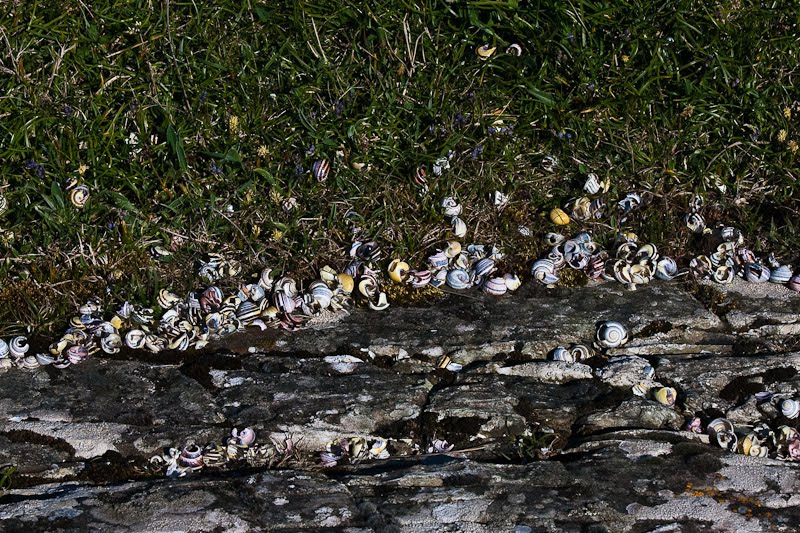

Thrush Anvil


At the back of the left hand end of the beach there is a cliff face which when my children were young used to have breeding Fulmars but these sadly have long disappeared. There is a small Sand Martin colony and for many years a pair of Ravens have bred here. For the last two years I have found raven corpses on the ground but this year they seem to have had better success with five young who are ow virtually fledged, see below. I had no idea that they had such a large clutch and it now makes me think in previous years that some of the young may have been pushed out of the nest by the others rather than more nefarious means that I had suspected.


Almost Fledged Raven Chicks


On the other side of the peninsula to the beach you usually find a couple of pairs of Shelduck who breed in the deserted rabbit burrows, occasionally you can find a Shelduck egg that hasn't quite made it into the nest. They have an extraordinary texture quite different from a chickens egg I can only describe it as more silky.


Shelduck Pair


It has come to the time of year that all the dogs will have to go on leads to protect the ground nesting birds and I hope the NIEA at the Quoile will be putting up signs shortly to enforce this. Below is a labrador that was enjoying playing in the sea.


Labrador out at Killard


The Northern Ireland Environment Agency are holding an event out at Killard on the 27th June I would highly recommend going if you have not been out there before, as it's a fab place.

6 May 2010

The Birdlife Community


I follow Birdlife International on Twitter and they post links to various stories about birds from around the world. These usually link to their Birdlife Community web pages.


At the moment they are very good at bringing the news about the oil spill in the Gulf of Mexico, which has to be particularly worrying at the moment. Here is one of their stories about all the Important Bird Areas at risk from the oil spill. 


This website really brings all the important bird conservation news into one place. Whether it is about the Illegal hunting in Malta , or about protecting wilderness areas in Poland , or a video about saving the Sociable Lapwing , or protecting the Carnaby's Black-Cockatoo in Australia , or bringing PEP (Birdlife's Preventing Extinctions Programme ) to the Pacific. The threat to the Houbara Bustard in South Africa, or even news about the Argentinians protecting the Southern Rockhopper Penguin .


There also links to Blogposts by various people who work for Birdlife International. Here is one by Barbara Neversil who works for Birdlife Switzerland at the moment these are mainly European but hopefully in time there will be blogs from Birdlife partners from further afield.


In addition there is a section of videos and in this example is Birdlife's Born to Travel Campaign.


You can follow "The Birdlife Community" a number of ways whether through
Facebook, Twitter, Youtube and by posting 
photos to their Flickr site so that they can use them free of charge.


The Flickr site is in it's infancy.


So I highly recommend that you bookmark this site and make regular visits.


10 Apr 2010

Bonefishing in the Bahamas

Bonefish and Fisherman

I am going slightly off the birding theme to this blogpost. The main reason I went to the Bahamas was to accompany my father bonefishing. A type of fishing that neither of us had experienced. Bonefish are considered to be among the world's best game fish to be caught by fly. At the end of the week we were both to concur with this view, even though I only spent one day out on the water my father went every day except for one and was pretty successful.

My Father and Bonefish

Here's The Old Boy (79) with a Bonefish on the Line ;-)

A Very Happy Robin Lane with Bonefish

Bonefish live in inshore tropical waters, moving onto the shallow tidal flats and into the mangroves to feed with the incoming tide, and retreating to deeper water as the tide ebbs. They range from around 2lb upto 14/15lbs.

The Bahamas and particularly Abaco where we were visiting has some of the best bonefishing in the world. On the western side of the island there is an area called the "Marls" which is about three to four hundred square miles of prime habitat for bonefish, consisting of shallow waters and miles and miles of mangroves. as the tide comes in they go and feed in amongst the mangroves looking for small crabs and shrimp.

Fishing for them is done by a number of ways some people wade from the shore and fish for them. This wouldn't be my preferred method due to the possibility of Bull Sharks and the possibility of standing on an Electric Ray. So for me it would be fishing from shore or by boat.

The Four Delphi Club Boats

One of the Delphi Boats out on the Water

The boat is the best option in my opinion, mainly because of the distance you can cover. All the Delphi boats have 40HP engines and can get you quickly to an area where your guide thinks that your chances are good. These boats have a very shallow draft that is to say you can propel them in inches of water. So the guide takes you to an area and then switches off the engine and climbs onto a platform at the back of the boat from where he will punt the boat. As he is quite high up he has a better angle of view for spotting the fish. If you are going out on the water it is also very important that you use good sunscreen as the chances of being badly burnt without it is very high. Good polaroids are also a must I have been using Maui Jims as I reckon they are one of the best polaroids on the market.

Ishy, our Guide Punting the Boat

Now Bonefishing is different to Trout and Salmon fishing. Firstly you have to spot them and they are pretty hard to see as a novice. Infact you rarely see the full outline of the fish unless the conditions are absolutely perfect. You are sort of looking for a shadow that is moving. On our first day our guide Ishy was saying "there's one set your fly in front of it" and we were going "where, where" our sight did improve however as the day went on. The other main difference with trout fishing is that I have always been used to lifting the tip of the rod when striking as the trout comes upto the fly. Whereas with bonefishing you are trying to put the fly, a barbless sinking fly, slightly in front of the bonefish in the direction it is swimming. With bonefishing the fly is bumped along the bottom so you tend to have the rod parallel to the water and strip the line in towards you. Bonefish have hard mouths, and when they take your fly, you need a quick, sharp pull to ensure you hook them . If you were to raise your rod tip as in troutfishing the result will be that the fly will be pulled out of the fish’s mouth. So when you see the fish and cast in front of it you then strip the line in towards you and your guide will probably be saying "strip, strip" and hopefully the fish has seen it and will be following the fly. You can then feel that it has it in its mouth and then you strip that bit harder to set the hook. Then Whoosh!!


On the day I went out I hooked two bonefish but lost them with the line getting tangled in the mangroves. It is a really exciting fish to hook as they absolutely race off and the sound of the line leaving your reel is music to a fisherman's ear. We also saw a few barracuda amongst the edges of the mangroves and Ishy asked if I wanted to have a go. So I swapped from fly fishing rod to spinner and on the second cast hooked this 15lb barracuda. It also shot off for a couple of really good runs and jumped out of the water a few times before it tired and I got it alongside the boat. Ishy then used his punting pole to land it. It certainly had pretty vicious teeth which you wouldn't want anywhere near you. Ishy's family had it for dinner that night.

Ishy, our Guide, Me and the Barracuda

One I Caught Earlier with Ishy and My Father

There are a quite a number of places on the islands that offer bonefishing but if you want the ultimate in luxury there is no better place than "The Delphi Club" which is situated on the south eastern coast of Abaco adjacent to the Abaco National Park.

Delphi Club from the Beach

Each evening after dinner, which is of Michelin starred standard , the General Manager Sandy Walker

Dishes created by The Delphi Club Chef Gareth Reid

organises which guests are going fishing and splits them up into their four boats. He also sorts out your pack lunch orders for the day. Sandy also decides on whether the boats will go out to the Marls on the west of the island , Cherokee Bay in the east or if the clients are taking a half day to the closer location of Crossing Rocks. This is of course weather dependent and the final decision isn’t taken until the morning. Breakfast is at 7.00am for those going fishing and will be served by one of these delightful ladies, who all work at the Club.

After Breakfast it is down to the boats to meet up with your guide for the day, who maybe one of the five Delphi Club Guides Donnie, Robin, Ishi, Joe and Tommy, and where final decisions are made as to where you are going fishing.

From then on its up to your guide to find the fish and for you to catch them.

I will tell you this you will have a fantastic time and by the time you return you will be exhausted and looking forward to your evening drink and meal in the comfort of the Delphi Club.


7 Apr 2010

Birding from the Delphi Club in the Bahamas Part 4

On my last morning I was going to spend a half day fishing with my father and it turned out that we were going to have to share the boat with another guest so as he was keener on fishing than I was I decided to, surprise, surprise, do my last bit of birding by walking the drive to the Delphi Club. In hindsight it was the best decision of the week.

As the boats all departed
I did my final walk round the two mile loop of the drive, infact I hobbled round as my left foot was very uncomfortable. On my return to Ireland it turned into a full blown bout of gout! The first bird of the day was a Merlin flying overhead. I had seen them every day that I was there. They are slightly different to the ones in the UK in that they have less bars in the tail feathers.


The other local bird of prey was an American Kestrel which flew towards me but was directly in line with the sun so didn't get a decent shot.


The other Birds of Prey that I saw during the week were an Osprey flying within 20 yards of the Delphi Club
and even more exciting for me was to see a Swallow-tailed Kite. (This is a heavily cropped image)
Infact when I went to tell one of the guests I noticed there were two of them and then I told another guest and as I was looking for them I saw eight in all . These birds were on migration and it was a good sighting as they weren't in my guide book for the island.

The vegetation on each side of the drive was filled with bird sounds of one form or another. The Thick -billed Vireo being the most common, followed closely by the Blue-gray Gnatcatcher.


There were Black and White Warbler, Northern Parula and the fairly common Black-faced Grassquit.


There were also feeding along the road edges some Common Ground Doves or Tobacco Doves as they are known on the island. They are absolutely tiny definately the smallest dove I have ever seen. They are about seven inches long.


The other dove that I was to see apart from Ring-necked Dove was the Zenaida Dove which also appeared on the drive.

Most days when I walked round the loop I would come across the Loggerhead Kingbird, these were fairly tame and would let you get quite close.

Whereas the Smooth-billed Ani weren't so accomodating.


One of the noisier birds is the Gray Catbird Listen HERE it could be found all over the lodge grounds.


Also in the Pine trees on the drive you could find the Olive Capped Warbler Dendroica pityophilia a near endemic looking for insects.


There were two Bahaman endemics to be found on the drive they were the Bahama Swallow and the Bahama Yellowthroat.


I was also very pleased to see another member of the thrush family. The Red-legged Thrush Turdus plumbeus.

Another bird that I saw was this beautiful little first year Prothonotary Warbler. I didn't know what it was and posted it on twitter and received replies very quickly and Anthony Mcgeehan texted me with the answer to confirm it for me.


As I was walking round the loop I could hear some Cuban Parrots about half a mile away and I was hoping I might get a better glimpse of them. When one landed in a tree right next to me. It was soon followed by another and within minutes there were at least twenty in the trees all around me. They stayed for about twenty to thirty minutes. I was elated that I got to see them so well and for a decent amount of time and then my camera's battery died :-(