7 Jun 2010

A Weekend at Delphi Lodge Co.Mayo starring a Pair of Common Sandpiper and a Dipper

I have just returned from a lovely weekend down at Delphi Lodge in Co.Mayo. I went down to meet my parents, who have for the last twenty plus years stayed in one of the Delphi Lodge cottages for the last week of May in order to fish for Salmon. It is one of my favourite spots in Ireland. It is between Louisbergh and Killary Harbour and about twenty miles from Westport. The Lodge is nestled in a valley between Doo Lough and Fin Lough(Which you can see above) The view below is looking from Finlough northwards up the valley.

I was hoping to see and maybe photograph Dipper as I have not seen any in the last couple of years.


After a five hour drive I was just in time to have lunch with my parents outside their cottage, which was made easier with a liberal dose of Autan (Kills Midges) Afterwards I had a snooze before heading down to the river below the house. It was one of those rare west of Ireland moments when the sky was blue and the sun blazing.
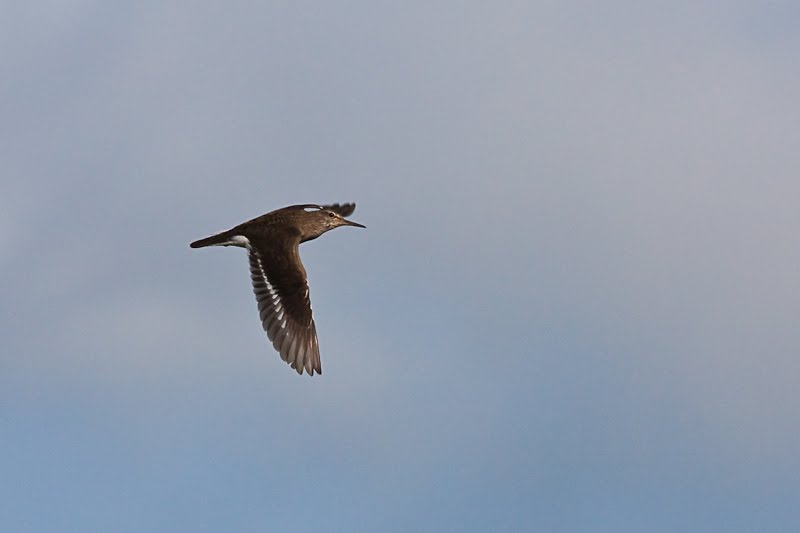
There were quite a few Sand Martins hawking for flies and Willow Warblers and Sedge Warblers could be heard. I then noticed a Common Sandpiper on a little rocky causeway that crosses the river calling.

Then I saw that it had a chick with it which was quite exciting and proof of breeding in the area.
It soon was out of sight and the parent flew off.
Pleased with what I had seen I made my way back to have dinner with my parents and some friends of theirs.

By the following morning the weather had reverted to drizzle interspersed with bright spots. After a delicious full Irish breakfast I headed out to take some shots of the lough in front of the house, it was mirror glass calm.

Here is a Black and White photo looking the other direction.
I'm think Delphi Lodge would make a fantastic venue for those interested in spending a few days photographing landscapes.

I then headed up the river and it wasn't before long that I saw a Dipper. Unfortunately not close enough to photograph and then it flew off up the river and I didn't see it again. I made my way upto Doolough and then came back via the road. There were a few Blackcap calling in the woods and a party of young Long-tailed Tits were chattering away.

Lunch was a Delphi Smoked salmon and potato pie and salad. mmmmmm :-)

In the afternoon I headed off to White Strand which as the crow flies is quite close but by car about 10. It is a fantastic beach with views towards Inishbofin. On the beach there were two pairs of Ringed Plover.
It looked very threatening weatherwise but we were spared the rain. This is looking southwards.
As is this.


This was looking North.


Out at sea there were a few Arctic Terns feeding and a pair of Great Northern Diver, which were quite close to the shore but by the time I got to them had swum out a bit.
It was a massive beach and there were only a few others on it. I believe Michael Viney, who has a great column in the Irish Times on saturdays, and writes about nature inspired subjects overlooks the beach. Lucky man.

Made my way back to Delphi and headed out with my long lens to see if I could get better shots of the Common Sandpiper. As I approached the rocky crossing where I had seen them the day before they were both calling very insistently and I was wondering whether it was me that was causing their disturbance.
So I moved away from them and the noise was just as bad, so I crawled back and lay down wondering what was going on. They were both only a couple of feet apart and one would fly up a few feet and land further down the crossing calling all the time. I had not seen the chick and assumed it was something to do with it when suddenly a mink appeared about two feet away from the birds before disappearing back under the rocks. This continued until the birds were almost on the far side of the river. At one point the birds were only a foot away from the mink and I thought it was definitely going to catch one. At this point both birds flew off. A few minutes later I saw the mink again and got this grab shot of it with an eel. I mistakenly had auto iso switched on which took this shot at 1600 iso and being a 40D camera body it is extremely noisy.

The mink swam down the river mostly underwater. The Sandpipers came back but again calling as they were flying. They seemed to be flying just over the water almost in a hover. I then saw bubbles on the surface and thought bugger the mink is back. But no this time two Otters were swimming up the river and the Common Sandpiper followed them closely. I just could not believe what I was watching. The only shots of the otters I got were as they were diving with both head and tail under the water so not great viewing.
After the otters disappeared round the bend in the river the birds came back and were flying around calling so I headed to the car and thought I would watch from a bend in the road that overlooks the rocky crossing. As I drew up there was one of the birds in the middle of the road before it walked to the edge.This shot was taken from the car.

I watched this going on for another five minutes and the other bird landed back down on the causeway.

At this point it was nearing 8 O'Clock and as dinner time I had to head back. I was thinking that the mink probably had caught the chick at this stage and after I turned the car round I had one last look and there was this chick running down the path beside the river. I went to dinner a happy man.

The food was delicious with a lovely starter of white asparagus, serrano ham and parmesan followed by a steak and a light lemon mousse for pud. Brill

On sunday morning it was glorious again outside and I decided to try for some dipper shots before breakfast. What was not glorious however was that it was warm and completely still and the midges were horrendous. I first of all heard this Willow Warbler calling from a small gorse bush and it had a massive mouth full of bugs.
The Dipper I had seen the previous day was half a mile away but I was fortunate to find one within a few hundred yards on the far bank.
It flew off pretty much as soon as I approached it. I got the next shot by hiding behind some bushes.
My preference is for the one below as it flew up this tiny tributary and was caught in the sunlight.

I would also like to take this opportunity to thank Peter Mantle for his generosity over the weekend.


30 May 2010

Inishbofin Co.Galway in late May and a Golden Oriole

I only decided on Sunday afternoon to go to Inishbofin, so I texted Anthony McGeehan and told him that I would come after all and that I would drive. I got a text back to meet him at 4:00am which slightly floored me, as I had been doing some outside catering work all day in the blazing sun and I was bog tired.

Anyway we met up and headed down to Galway. We went a different route to my normal, which is slightly longer. We went via Omagh , Ederney, Belleek and Ballyshannon. This way was a revelation as the roads this way are brilliant compared to going via Enniskillen, Blacklion and onto Sligo. We stopped off around 6:00am at Castle Caldwell Forest Park to see if we could see or hear any Wood Warbler. No luck only a couple of Blackcaps and a Red Squirrel. So onwards and after having breakfast in Westport we drove the remaining 40 miles to Cleggan for the ferry.

It was an absolutely glorious day with clear blue skies. The Connemara mountains looked absolutely superb. Not much to see on the way over to the island apart from the passing Herring Gull and a few Guillemots diving as we approached. The island right next to Cromwell's Fort, at the entrance to Inishbofin Harbour, had about 25 Arctic Terns sitting on it.

We then were collected by Paddy Joe in whose cottage we were staying, below.


Paddy Joe's Cottage

 I made a quick lunch and then told AM that I was going for a kip before we headed out. Three hours later I woke up. We then headed out to the East of the Island and we saw the odd Sedge Warbler, a few Stonechats, lots of Wheatears all of whom seemed to be feeding young. We were heading for Dun na hInine where you can watch Fulmars and as we neared it a Chough flew really close by.


Chough in Flight

By now it was nearly 9.00 so we headed back to the cottage via the beach on the east end. There were a couple of Dunlin and eight Ringed Plover which looked great in the low evening light.


Ringed plover in Evening Light


We had just gone past the graveyard when I spotted a Spotted Flycatcher my first of the year and then when we got back to our cottage Anthony spotted another hawking flies in the garden.
After supper and a couple of beers I slept soundly until 9.30am

It was again a beautiful sunny day with a light but cool breeze. Today we were going out to the west end of the island. Anthony was doing a Birding weekend in conjunction with the Dolphin Hotel for 12 people. and he wanted to do a dry run of one of his walks and see what birds were about. So we made our way and first of all came across a Wren bringing food to it's young on the edge of the harbour. There were also a couple of Black Guillemot in the harbour. As we were walking there were a few Wall Brown's and a Peacock Butterfly on the Thrift.


Wall Brown Butterflies


Peacock Butterfly on Pinks


We stopped off at the Doonmore Hotel for a nice Bewleys coffee and scone. While we were sitting outside this sheepdog came past carrying its owner's cigarettes.


Sheepdog and a Packet of Silk Cut

After coffee we tried to see the Corncrake that had been calling at George Lacey's farm, a few hundred yards further on, but we didn't hear or see it. There were reports of 2 birds on the island one being this one and another at the opposite end of the island. We continued to Dun mor promontary where thousands of years ago there used to be a fort. This takes you past what has to be one of the best beaches in Ireland if not the best.

One of Ireland's most Beautiful Beaches


From the top of Dun mor you can see Fulmars nesting on the edge of the cliffs and a pair of Choughs flying around. I'm not very good with heights so wasn't prepared to get too close to get photos. I did get this Fulmar.


Fulmar at Dun mor

The view North-East from Dun mor is spectacular it looks towards the islands from the right Inishturk, Clare Island and Achill Island.


Looking from Dun mor towards Clare, Inishturk and Achill Islands

Here is the view looking back at Dun mor and Inishshark from the big rock in the above picture.


Looking past Dun mor towards Inishshark

This area had quite a few Ringed Plover nesting and even though it is on one of the waymarked routes around the island they were nesting within yards of the track. We were watching them as the tourists made their way past and apart from walking away from the nest none of the tourists seemed to be aware of them.


Ringed Plover's Nest

We also came across this Redwing corpse, which was probably one of the thousands that were seen on the west coast of Ireland during the very cold winter we have recently had.


Redwing Corpse

We continued on our walk and came across a pair of Common Sandpiper which were probably breeding  but are extremely difficult to pin down. Then when we got back to Lough Bofin there was another Common Sandpiper as well as about five pairs of Lapwing which also breed down this end of the Island. On the lough itself was a Mute Swan nest on a little island which in previous years had been a breeding site for Common Terns . A few Mallard were about but not much else.

We finally got back to the cottage at about 5.30pm and after a cup of tea I went for a kip. No sooner had I got to sleep there was a banging on my bedroom door with Anthony saying he thought he had seen a Golden Oriole. We raced out to where he had seen it fly to and as we rounded the corner it flew off towards the harbour. I got a few photos but they were small dots as it was also flying into the sun they were almost impossible to identify. We eventually tracked it down to a small clump of willow near the harbour and at some distance got a few distant shots. I unfortunately hadnt noticed my Fstop was F14 which made most of the shots taken very blurry.


Golden Oriole in Flight

Well I was really chuffed to see a Golden Oriole in Ireland and especially on 'Bofin. I had seen them in Italy and Suffolk but never thought it would be in Ireland. The bird was fairly secretive and kept going back into the willows before flying off back towards Regina's garden. It then flew out past the Dolphin Hotel and we didn't see it again that evening. We headed out past the Dolphin to look for Grasshopper Warbler of which a number had been calling. We saw one a few times but never long enough to get a photograph. One of my bogie birds.

In the morning I woke up and found that Ant was nowhere to be seen so I decided to keep a watch on the garden from one of the bedroom windows and almost immediately the Oriole flew into a sycamore tree and disappeared. I waited and waited and then 25 minutes later it popped up and I got this shot.


Golden Oriole in Regina's Garden

Then it disappeared again and a minute later popped up elsewhere in the bush and I got this one. It then flew off to the small patch of trees behind the garden.


Golden Oriole in Regina's Garden

It was good that it was still here as a couple of birders were coming over to see it. We went down to meet them from the ferry and stopped off at the churchyard to have a look on the way and it flew out as we arrived. Unfortunately when we showed them all the areas we had seen it, it was nowhere to be seen.
After a while we split up and they did eventually catch up with it again in the churchyard.

We went upto the airfield to see how the lapwings were fairing there only to find two pairs and a small number of Ringed Plover. I climbed to the top of the island to take some photos only to find there was a large amount of dust on my sensor and no useable images.

We had been invited by the owner of the Dolphin Hotel Pat and his wife Jackie to a barbecue supper that evening which was a real treat. We had delicious steaks and salad sitting outside. Their five year old daughter Ruby had a keen interest in my binoculars. After dinner I headed out to  Dun na hInine on the east of the Island to get some more shots of Fulmars. I virtually ran most of the couple of miles out there as the sun was getting lower and lower in the sky and was really too late. However I got these photos of both a Fulmar and a Peregrine in the sunset.


Fulmar in Sunset

Click on the Photo for larger views.


Peregrine in Sunset

As I made my way back the moon was rising and it looked  pink in the sky an absolutely lovely evening made worse by the fact I was walking in my crocs and thought I would make a short cut across a bog to get ompletely stuck. To the point where my foot came out and I had to free it by hand. I never realised how difficult it is to wash off wet peat from my feet.


Moon rising over Inishbofin

The following morning I went and photographed some Wheatears.


Male Wheatear


Female Wheatear


I had a wonderful four days and look forward to going back for a week in October if not sooner.
The islanders are really friendly and always give you a wave as they go by or even stopping for a chat.
The only thing I thought was a bit unnecessary was this sign on a gate. Of course I had to take a photo.
Considering tourism plays such a large part in the economy of this island it seems strange to see something like this and really a bit sad. We spoke to a couple of islanders about it who thought it was dreadful.

14 May 2010

Cuckoo Cuculus canorus in Donegal

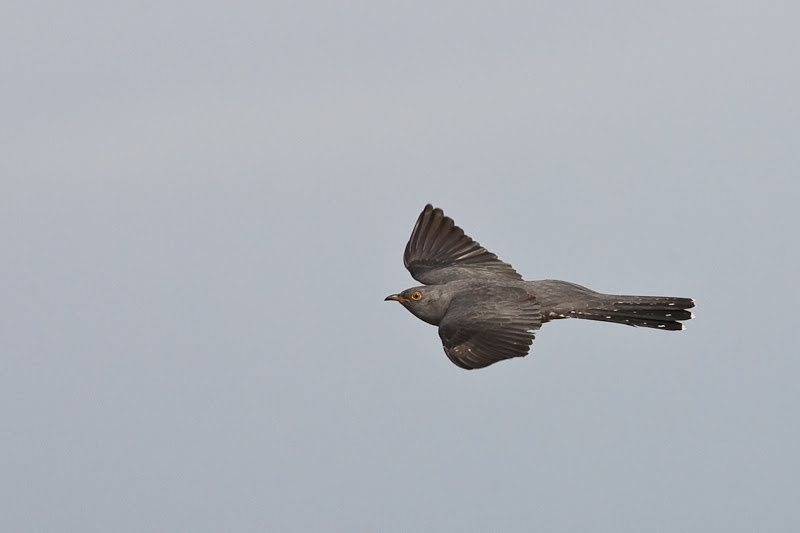
I have been up in Donegal for a week and the highlight for me is that there has been a Cuckoo around my parents farm and even as I type this I can hear it. It hasn't been easy to photograph and I have followed its calls all over the place. From the edge of Lough Fern, where there were loads of Sedge Warbler singing, to the Rath at the top of the hill above the farm. It has on a couple of occasions flown directly overhead and both times when I was in the garden.


After the first day it decided to wake us up at 3.20am in the morning and sang continuously for an hour this was in the tree directly outside our back door. I even recorded it from my bed and this is with the window closed. You can listen to it here .


On the second day after only getting the above shot I decided to go and see if I could add Grouse to my year list and so headed towards Glenveagh to a spot I have seen them before. When I got out of the car there were Grasshopper Warblers reeling away and over a period of 500 yards I reckon I heard three different individuals, but no sighting. Then I heard a Cuckoo in some pines over to my left and eventually spotted it sitting on the top of a small pine being mobbed by meadow pipits. It then flew low in front of me and I got these two shots.


I then headed on down the track and flushed a Grouse within fifty metres of where I saw one last year and the previous year. Unlike the last time it had gone before I could focus on it.

As I was coming back the Cuckoo then flew past me and I got my favourite shot.


So a pretty good few days. I have only one previous shot of a Cuckoo out at Killard and find them quite difficult to find let alone photograph so to get two different birds in two days was a real bonus.

10 May 2010

Killard Nature Reserve in May

I love Killard Nature Reserve. Below is an aerial photograph taken by Photographer Mike Hartwell of Northern-Eye. It shows Killard half way between high and low tide it also shows the Strangford Narrows going up past Portaferry and Strangford into Strangford Lough itself.


Killard is the peninsula leading out into the sea. I visit it all year round sun, rain, wind or snow. Well snow is pretty rare. But it is this time of year I look forward to the most. All the flowers start to appear again It is usually the primroses followed by the heath dog violets, then the spring squill and then the orchids.

Primroses


Spring Squill


Heath Dog Violet


Thrift


As well as the flowers there are also the returning migrants either passing through such as the Whimbrel, Wheatear and Dunlin, or staying to breed like the Whitethroats. The air is filled with the song of Skylark,The Whimbrel are calling, The Whitethroat sing in the hedgerows. All in all a great time of year.


Whitethroat


There seem to be less Stonechats around, which seems to be the general conclusion throughout Ireland probably due to the severe winter. There is one pair of which the male can be photographed fairly easily.


Male Stonechat


Some days you can see lots of Wheatear others only one or two. I find them fairly hard to get close to.


Wheatear


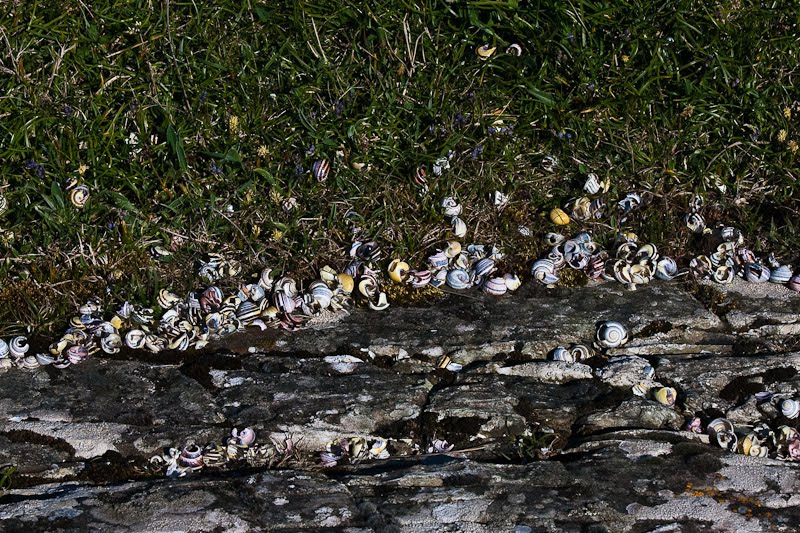
Over the last few months one of the things I had been noticing was the large amount of Brown-Lipped and White-Lipped Snail shells broken at the base of rocks. It wasn't until I bumped into Brian Black (UTV Environment Correspondent) that he asked me if I had ever seen any thrushes out there as he had wanted to film them. I had to say I hadn,t. I occasionally see the odd Blackbird out there but it is only the Song Thrush that uses these rocks for breaking the shells. They are called Thrush Anvils.


Thrush Anvil


At the back of the left hand end of the beach there is a cliff face which when my children were young used to have breeding Fulmars but these sadly have long disappeared. There is a small Sand Martin colony and for many years a pair of Ravens have bred here. For the last two years I have found raven corpses on the ground but this year they seem to have had better success with five young who are ow virtually fledged, see below. I had no idea that they had such a large clutch and it now makes me think in previous years that some of the young may have been pushed out of the nest by the others rather than more nefarious means that I had suspected.


Almost Fledged Raven Chicks


On the other side of the peninsula to the beach you usually find a couple of pairs of Shelduck who breed in the deserted rabbit burrows, occasionally you can find a Shelduck egg that hasn't quite made it into the nest. They have an extraordinary texture quite different from a chickens egg I can only describe it as more silky.


Shelduck Pair


It has come to the time of year that all the dogs will have to go on leads to protect the ground nesting birds and I hope the NIEA at the Quoile will be putting up signs shortly to enforce this. Below is a labrador that was enjoying playing in the sea.


Labrador out at Killard


The Northern Ireland Environment Agency are holding an event out at Killard on the 27th June I would highly recommend going if you have not been out there before, as it's a fab place.

6 May 2010

The Birdlife Community


I follow Birdlife International on Twitter and they post links to various stories about birds from around the world. These usually link to their Birdlife Community web pages.


At the moment they are very good at bringing the news about the oil spill in the Gulf of Mexico, which has to be particularly worrying at the moment. Here is one of their stories about all the Important Bird Areas at risk from the oil spill. 


This website really brings all the important bird conservation news into one place. Whether it is about the Illegal hunting in Malta , or about protecting wilderness areas in Poland , or a video about saving the Sociable Lapwing , or protecting the Carnaby's Black-Cockatoo in Australia , or bringing PEP (Birdlife's Preventing Extinctions Programme ) to the Pacific. The threat to the Houbara Bustard in South Africa, or even news about the Argentinians protecting the Southern Rockhopper Penguin .


There also links to Blogposts by various people who work for Birdlife International. Here is one by Barbara Neversil who works for Birdlife Switzerland at the moment these are mainly European but hopefully in time there will be blogs from Birdlife partners from further afield.


In addition there is a section of videos and in this example is Birdlife's Born to Travel Campaign.


You can follow "The Birdlife Community" a number of ways whether through
Facebook, Twitter, Youtube and by posting 
photos to their Flickr site so that they can use them free of charge.


The Flickr site is in it's infancy.


So I highly recommend that you bookmark this site and make regular visits.