13 Dec 2010

My Favourite 40 Books about Birds, Birding and Bird Photography (Part 2: The Second Ten)

11. Top 100 Birding Sites of the World by Dominic Couzens
I really like this book as it fills you with pipe dreams of where you could go birding in the world. Do I want to go to Merzouga in Morocco to catch up with the Houbara Bustard, Andasibe in Madagascar to see the Common Sunbird-asity, Abra Patricia in Peru to see the Marvellous Spatuletail, a pelagic in Monterey Bay off the coast of California to see the Black-footed Albatross or the Bale Mountains in Ethiopia to see the Spot-breasted Lapwing. It just fills you with dreams of birding in foreign shores.

12. Birds of Southern Africa by Ian Sinclair (originally from Northern Ireland) Phil Hockey and Warwick Tarboton
This has to be in my opinion the guidebook if you are going to the Southern half of Africa. I used it on my visit to Namibia and found it invaluable. You can even get it now as an app for the Iphone.

 13. Down the Long Wind by Garth Christian
My parents have had this book for as long as I can remember and I would have read it in my teens when I had a voracious appetite for reading. It was published in 1961 and is all about bird migration.
 14. The Big Twitch
This to me is the best twitching book that I have read. It is gripping, amusing and unputdownable. Sean Dooley tries to break the record for the amount of birds seen in Australia in one year. Not that I have the inclination to do a big year, well maybe I might be keen on photographing as many birds as I can in one year. However in the book Dooley writes "infact the older I got, the more important birdwatching became to me. It went from just a hobby to being fundamental to my sense of self and a vital component in maintaining my mental health." I feel in total agreement with this comment as do I am sure many other birders. Go get it it's the best twitch book there is.
 15. Shorebirds by Hayman, Marchant and Prater
An excellent guide to the Wader species of the world. Hayman doing the illustrations which I think are excellent. A couple of years ago I bought a plate of Black Grouse that Hayman did for the Birds of the Western Palearctic Concise Volume 1. I think highly of his skills as a bird illustrator.
16. Border Reflections by Lord Home
In my teens I used to shoot and fish alot and I was given this book by my father. It is a signed edition by Lord Home (pronounced Hume) who was Prime Minister from 1963 to 1964. The book was illustrated by Rodger McPhail an outstanding sporting artist. Even though I gave up shooting four to five years ago it is one of my favourite books. Strangely a few years after I received it I was travelling through Europe on the Interail. I met three girls from London on a train in Italy and I continued travelling with them for a few weeks and one of them, Fiona, who I quite fancied, was Lord Home's granddaughter.
17. Masterpieces of Bird Photography by Eric Hosking and Harold Lowes
This book was published in 1947 and has amazing black and white prints of birds photographed in Britain going back to as early as 1892 by the Kearton brothers. There is a great photo of a pair of Black Throated Divers at their nest in Argyll taken by J.E Ruxton. It was taken with 8.5 inch focal length lens which today would be a 200mm lens at f8 for 1/4 second. Amazingly the photo is sharp.
Even in 1914 Douglas English, President of the Zoological Photographic Club, was concerned with photographs of captive species. He wrote "The true function of nature photography is to record and illustrate natural phenomena, without addition, without suppression, and above all things, without exaggeration of the difficulties involved." He also wrote "publication of a natural history photograph which purports to be a photograph from life, but which is in fact a photograph of a posed specimen, is in our view, a contemptible form of dishonesty" !!!!

 18. Blokes and Birds edited by Stephen Moss
My sister gave me this for my birthday six years ago. It is pieces written by well known members of the British Birding community and relates a tale by each of them and also mentioning their favourite bird. On one side of each page there is a nice black and white portrait of each birder.
19. Flight Identification of European Seabirds by Blomdahl, Breife and Holmstrom
I bought this when I first started to seawatch in the hope that it may help me identify seabirds. It is a photographic guide and pretty good. My only point against it is that most of the photographs are taken on really beautiful days and in reality the weather on a seawatch is rarely as nice.
 20. The Sibley Field Guide to Birds of Eastern North America
This is my latest acquisition as I thought it maybe helpful if I found an American bird on Inishbofin and didn't know what it was. It's a really nice guide and nicely illustrated. I use it quite often when reading American Birding blogs and am not sure about the species that is been talked about.

28 Nov 2010

My Favourite 40 Books about Birds, Birding and Bird Photography (Part 1: The First 10)

These are the first ten of my favourite books either about Birds, Birding or Bird Photography. They are in no particular order of favouritism as I find on some days I am more interested in one particular book than another.


1. Birds of Europe by Lars Jonsson
To my mind the most beautifully illustrated Bird guide in the world. Lars Jonsson has to be one of the finest bird illustrators there is. One day I intend to go to his museum in Sweden and buy one of his illustrations.


2. Thorburn's Birds by James Fisher
This was the book that started it all for me. I was given this book as a 5th birthday present by my paternal grandfather. The illustrations by Archibald Thorburn are quite superb, he is definitely one of my favourite bird artists. I have a couple of signed prints one is a pair of Nuthatches and the other a Woodcock. Unfortunately the cover on my book disintegrated years ago. So below is one of the plates from the book.


3. Readers Digest Book of British Birds
This would have been my first guide book, which not that I knew it at the time was seen to be a breakthrough in bird guides in that era (Early 70's).  It was illustrated predominantly by New Zealander Raymond Ching for the main plates and Robert Gillmor for the line drawings. It has been well thumbed over the years.


4. The Eye of the Wind by Peter Scott
This is Sir Peter Scott's autobiography. He was one of the founding fathers of modern  conservation and bird painter. He founded the Severn Wildfowl Trust , which is now The Wildfowl and Wetlands Trust


5. An Eye for a Bird by Eric Hosking
For forty years from the beginning of the 40's Eric Hosking was Britain's most renown bird photographer. This is his autobiography. He photographed 1800 species of bird in his life and don't forget this was prior to digital photography. Up until the 60's he was using medium format before changing to 35mm. In thirty years he said he took around 150,000 photographs. Nowadays a full time bird photographer would be taking that amount in a year or two. In 1949 he took this photo of a hovering Nightjar. Even nowadays you wouldn't find many bird photographers being able to take a shot like that.


6.  The PEREGRINE Falcon by Derek Ratcliffe
I bought this signed edition in the last few years off someone from Birdforum it was published by T & AD Poyser in 1980. It is a fascinating book which covers the Peregrine's biology and the effect that pesticides had on their decline in the UK. It was later updated in the 90's. Derek Ratcliffe's most important legacy was the National Nature Reserves and Sites of Special Scientific Interest (SSI's) set up when he was the chief scientist of the Nature Conservancy Council


7. Finding Birds in Ireland by Eric Dempsey and Michael O'Clery
If you are visiting Ireland and want to go birding I reckon this book Finding Birds in Ireland and the Birds of Europe by Lars Jonsson are all you need. It covers every County in Ireland and is very detailed. For example one of my local patches is the Quoile Pondage. It gives you good directions how to get there, the species of bird you are likely to find year round and then a list of the seasonal birds as well as a list of the rarities that have been found there.


8. The Shorebird Guide by Michael O'Brien, Richard Crossley and Kevin Karlson
This is mainly a photographic guide from America that relies on looking at the birds size, structure, behaviour and colour patterns at different stages in their life cycle. The photography is quite superb. I have a number of shorebird guides and this is definitely one I would turn to first. Richard Crossley is publishing the Crossley ID Guide in April which will be a very different photographic ID book to those in the past.


9. Bird News Vagrants and Visitors on a Peculiar Island by E. Vernon Laux
This book is about a year in the bird life of Martha's Vineyard, an island off the coast of Massachusetts. I lived on Martha's Vineyard on and off for nearly five years in the eighties and was sent this book when it came out. I have read it a few times and reminisce what I might have seen. At the time I wasn't quite as fanatical about birds and even though I saw Cardinals,  Blue Jays and Common Grackle and even at one time killed four Northern Bobwhite when they flew in front of the van I was driving. I look forward to going back there one day.


10. The Birds of the British Isles by Bannerman and Lodge
This is a series of twelve volumes completed during the 50's and early 60's. They belonged to my grandparents only two still have their original cover. The illustrations were all done by George Edward Lodge one of the finest bird artists at that time.


24 Nov 2010

Wordless Wednesday

Grey Plover (Click on Image to see in larger form)

21 Nov 2010

Waxwing in Belfast

Waxwing

I popped up to Belfast this morning hoping to photograph some Waxwings. I parked in a carpark adjacent to the River Lagan. I could hear the Waxwings as soon as I got out, little did I think when I left home that the carpark would be absolutely full of people, rowers, joggers etc. Too many people and there were initially only five waxwing to be seen high up in a tree over looking the carpark. I also met up with fellow bird photographer Danny Boyd who was also hoping to photograph them as well. He showed me his new camera of which I was fairly envious :-) Sadly the birds didn't play ball and flew off.

So we went our separate ways and I headed in the direction of where I had seen them fly. Luckily there was one in a tree on its own and I was able to get a shot.


17 Nov 2010

Links to Bird Photographers

I have been recently adding a few photographers from all over the world to my links on the right of this page.

From Brazil we have Octavio Campos Salles  He runs photo tours and takes great photos  his blog is HERE

A Female Amazon Kingfisher from the Pantanal by Octavio Campos Salles


From Canada we have Greg Schneider who has to be one of Canada's leading Bird Photographers his website is HERE and he has a blog HERE


Male Pine Grosbeak by Greg Schneider

From England I have added Jules Cox a Wildlife Photographer whose site is HERE and his blog is HERE
Female Common Kingfisher by Jules Cox

From South Africa I have added Morkel Erasmus his website is HERE and his blog HERE  Morkel had a Highly Commended photograph in the 2010 Veolia Wildlife Photographer of the Year competition. 

Giant Kingfisher by Morkel Erasmus

Also another Wildlife Photographer from England Austin Thomas his website is HERE and his blog is HERE 

Swallow in Flight by Austin Thomas


4 Nov 2010

Birding on Inishbofin October 2010

Male Stonechat
Click on Images to see in New Window

I have recently returned from an absolutely brilliant week on Inishbofin Co.Galway. I was not sure whether to title this blog post "Inishbofin I Love You" or the above but as this blog is generally about birds I went with the above. I am exhausted and sore from leaving the house at first light, walking and searching for birds all over the island and returning at about six thirty every evening.

I arrived on Sunday by ferry to find a body being lifted out of the harbour by the RNLI. Two men from Castlebar had drowned in the early hours of the morning after leaving a bar at two in the morning. Sadly the same old story of two people with too much alcohol on board making their way back to their boat by dinghy, the dinghy had been tied up to their motor cruiser and it looked as though it flipped over when they were trying to board the bigger boat. Both men were found with inflated lifejackets. It should really never have happened as the two men had been offered a bed to stay on the island for the night . Some of the islanders were extremely unhappy that they were attempting to do so on a moonless night and one even switched his car headlights on to illuminate the harbour for them.

I was picked up at the pier by Paddy-Joe King and taken to the cottage where I stay while on the island. I unloaded all my gear and stocked the kitchen cupboards before heading out with my binoculars and camera. I was meeting Anthony McGeehan later in the day after he had finished leading a birding tour. However it was only a few minutes later that I bumped into him near the Dolphin Hotel with his charges. He knew I hadn't seen a Ring Ouzel before and said that they had just seen one near the graveyard. He said it was a first winter bird and that if I was lucky I might also connect with an adult bird that they had seen earlier in the morning. Well I made haste to the graveyard where there were also quite a few blackbirds and then I heard the Ouzel before I saw it. It was the first winter bird.
1st Winter Ring Ouzel

A lifer in the first hour on the Island. Things were looking up. I headed back to the Dolphin and joined Anthony and his guests before we headed back to our cottage.  We went out in the afternoon and saw Whitethroat, Blackcap, Brambling, Tree Sparrow, lots of Stonechats, Redwings, Song Thrushes and just before we got back to the cottage we heard some Choughs.

Before I arrived on Inishbofin Anthony had sent me a text to say not only to bring my binoculars but to bring my ears. In some ways almost as important as the eyes. I am a slow learner but as time goes on I spend more and more time listening to the bird calls and trying to identify them, you eventually become tuned in to their specific calls. As I sit here writing I can hear a Dunnock in my garden along with some Long-tailed Tits. Whenever I go out to Killard I usually hear the Reed Buntings before I see them with their plaintive tseu . Anthony has a fantastic ability in identifying bird calls and then the ability to transcribe them onto paper. On one morning he said "can you hear it?" I couldn't. But as the bird got closer and closer I eventually could hear this Snow Bunting with its teuw followed by tiririririririp flying over head with its white wing patches visible. He would occasionally ask me how to transcribe the sound which I found difficult but it certainly made me think alot more to what I was hearing. One evening I played various American bird calls from my Ibird pro app on my phone to test him and he was rarely wrong. I now listen to a different bird call each night before I go to bed in the hope that with a bit of repetition it will lodge itself in the recesses of my brain.

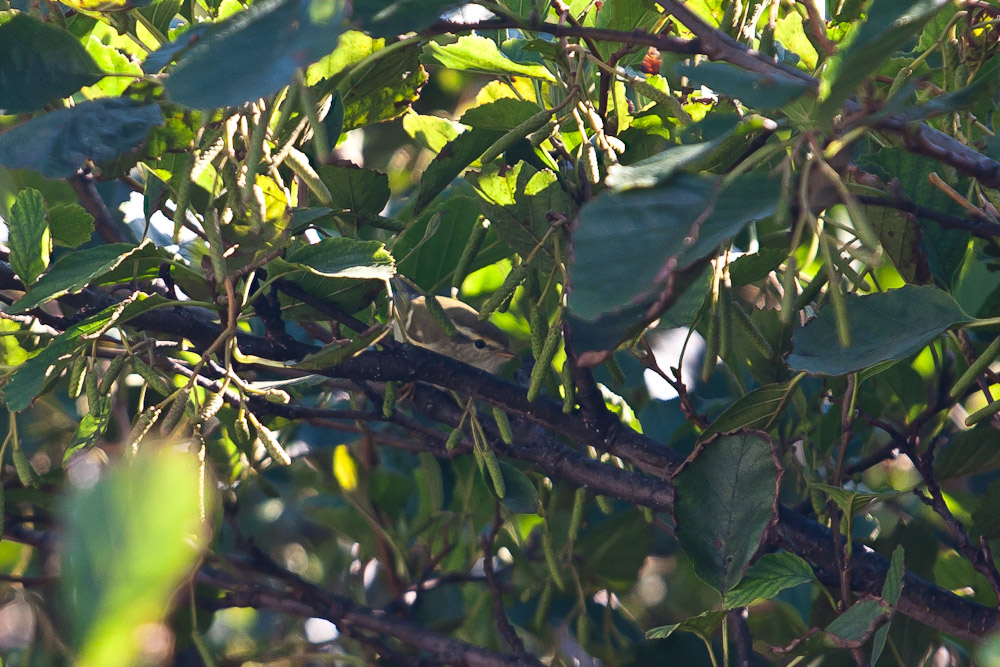
On Monday morning it was an absolutely fab day with clear blue sky and a lovely sunrise. Each day we had breakfast and were out of the house by eight. Every morning we would first check a small plantation of alder and sycamore that Anthony had planted. We were straight onto a very pale chiffchaff of the northern race. There were a number of meadow pipits flying overhead. Then we headed back to the garden in where we were staying and I spotted a Yellow-browed Warbler which I had never seen before. Anthony didn't see it and then I was beginning to doubt whether I had seen it, especially as we went and looked from the other side of the hedge and the first two birds that we spotted were more chiffchaffs. Then the Yellow-browed popped up again. RELIEF and another lifer. Two in two days was this going to keep up I asked myself.

Hidden Yellow-Browed Warbler

We then headed to the east end of the island and Anthony spotted this Pied Flycatcher which was the second time I had seen one; the last time being on the island in a previous year. We spent a while gradually getting closer to get some photos.
Pied Flycatcher

Pied Flycatcher
We left this spot and headed to Irene's garden where I had previously seen one. Only a couple of Blackcaps and not much else apart from a Golden Plover calling overhead. Below is a youtube clip of the view.


We then headed to the cottage for some lunch via the graveyard. Again loads of Blackbirds, Redwings, Song Thrushes and Blackcaps. As we are approaching the Dolphin Hotel Anthony says did you see that. I say no :-( then this bird pops up and he says "Barred Warbler". My third lifer in two days.
Barred Warbler

We were lucky with this bird as it stayed in the area for four days. It was feeding on the blackberries and in another photo it has a very red/purple back side!

In the afternoon we headed to the west end of the island via Lough Bofin here we found 2 Pink Footed Goose and 1 Brent Goose. On some days the Brent Goose would be on the east end of the island eating weed from East Bay and on others it would be at Lough Bofin. We then headed to a house where there are a couple of willow bushes and we found two blackcaps. Over the whole week we saw quite a few sometimes as many as four together. I took this shot of one at the hostel.
Male Blackcap

Each evening we would head back to the cottage and I would cook the dinner for the both of us this was usually in exchange for lighting the fire and the washing up. My least favourite jobs.

We were up at first light on the tuesday morning and yet again it was an amazing day. The Yellow-browed was still in the garden, the Barred warbler was in roughly the same place and a Spotted Flycatcher was near the graveyard and unusually a Tufted Duck was on the little lough beside the graveyard.
Spotted Flycatcher

We carried onto the beach next to Inishlyon and decided we would come back in the winter to tidy up all the rubbish which has accumulated on the high tide line. Then it was onto the willows where we found the Cedar Waxwing last year. This year it was very different from last year. Last year there were always a few phylloscs in the bushes every time we visited. This year a single chiffchaff on one day. So we headed up the field to Irene's Garden and I spotted a Pied Flycatcher which I assumed to be the same bird as the previous day. I took quite a lot of photos and it wasn't until that evening when Anthony I were looking at them that he said that it might not be a Pied but there was a possibility that it might be a Collared. He felt there looked as though there was the sign of a second wing bar and that the pale mark on the primary coverts was very close to the wing edge. His inclination was that it was probably a Pied Flycatcher.
Mystery Flycatcher

At the time we were out of internet contact and weren't aware that another similar bird had been spotted on Cape Clear ninety miles south of us. This bird had been trapped and a DNA sample taken. Here is a link to the Cape Clear bird from Paul and Andrea Kelly. I have to say I think it looks very similar to our bird and also to this bird found at Spurn Head. Here is a link to Martin Garner's website Birding Frontiers" 

One afternoon I headed out to the west of the island and came across a party of thirteen Chough feeding on the turf. These birds were probably the total island population. They are such a fabulous bird fairly talkative calling their distinct Che-oww call but never really letting me get that close to them. I got this silhouette photograph.
Chough

 As I made my way back from the westquarter I passed what I regard as the Most Beautiful Beach in Ireland.
Fab Beach on Inishbofin

As I made my way back there were loads of rabbits all diving into their burrows. This one remained outside his burrow long enough to photograph.
Inishbofin Rabbit

 I passed the memorial stone to the three men that had drowned on Easter Sunday 1949 on their way back to Inishshark
Ruins on Inishshark

and as I did so I heard a Chough calling close by just above me on the hill so I was able to photograph it in the setting sun. The Choughs seem to roost in a cave on the hill overlooking the cottage we stay in along with a pair of Ravens.

Chough 

As I continued my walk back to our cottage I passed Day's Bar and was rather taken by these two dogs sitting on the wall.

Dogs outside Day's Bar on Inishbofin

One of the things I love about Inishbofin is the opportunity to photograph the more common birds. Here is a Female Stonechat and a Dunnock.

Female Stonechat
Dunnock

One morning we went past the graveyard and out to the beach before following the coast round to East Bay and we saw two Great Northern Divers and in the water just below us was a shoal of these Grey Mullet.
Grey Mullet

I had a wonderful week seeing 75 species of bird including three lifers in absolutely gorgeous weather and yet again learnt more and more about different species. It was a shame I had to drive back on yet another beautiful day here was the view from the ferry back to the mainland. I will be back.


Looking from Inishbofin to the Galway Coast


25 Sept 2010

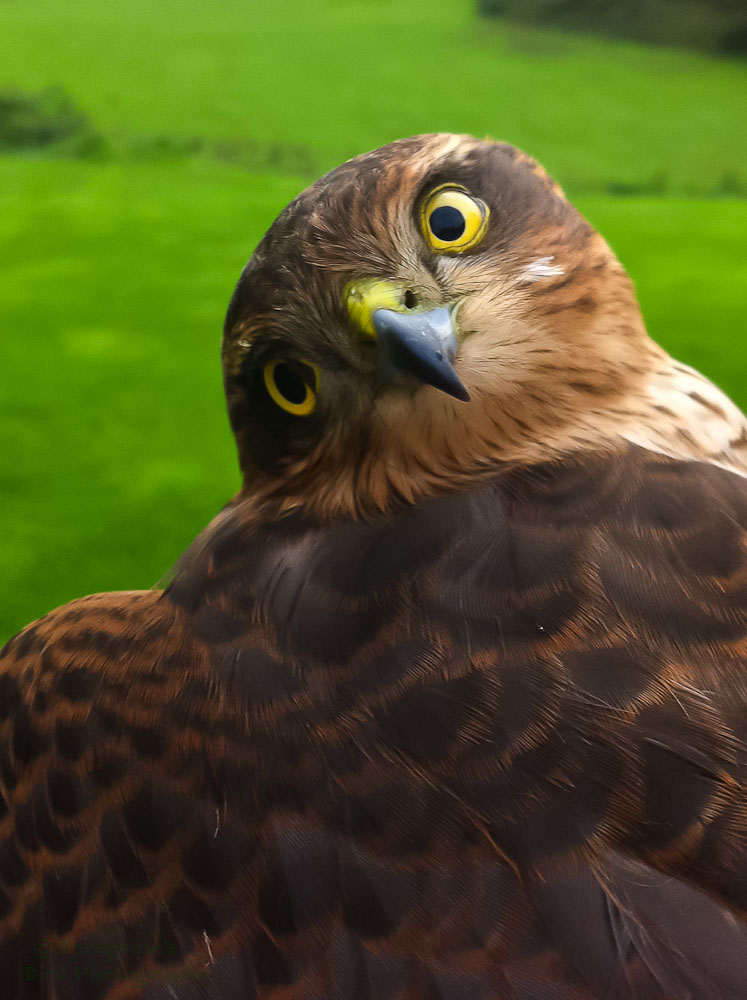
A Rather Dazed Sparrowhawk. Photo Taken With An Iphone

I arrived home from work and was sitting at my living room window. I had been sitting for a while reading "The Biggest Twitch" by Alan Davies and Ruth Miller and was quite surprised that nothing was coming to the bird feeders especially my window based one. Then I noticed a juvenile Sparrowhawk sitting on the ground with it's eyes closed and it's head twisted around on it's back. So I went out and picked it up remembering how Staffan Roos from Queen's University held a Sparrowhawk at a BTO bird ringing course a few years back.  I then took the following photos with my Iphone 4. It spent nearly half an hour with one of its eyes closed before before it flew off. It flew in a couple of circles round the house before settling in a tree where it remained until dark.

I have to say I have been very impressed with the quality of photograph for a phone.
Juvenile Sparrowhawk

22 Sept 2010

I Thought For A Moment I Had Found A Rare Wheatear and The One Legged Redshank


I was out at Killard Nature Reserve this lunchtime and I noticed a small pale bird fly up and land down on the shoreline. I put up my binoculars and my heart was racing as I thought initially I had found a rare Wheatear. Not knowing the family particularly well I wondered whether it might be a Desert Wheatear or Isabelline and beyond those I wouldn't have a clue. I got close enough to photograph it and was really looking for some obvious black detail in the feathers in the tail.
Leucistic Wheatear

Then it flew off and you can see from the photo below that it was a very pale colour where the black should have been and from that I assumed it had to be a leucistic Wheatear.

Leucistic Wheatear in Flight

On my way back I saw in the distance this Peregrine chasing a Sparrowhawk. It was a pretty close thing and in the end the Sparrowhawk just dove straight into a crop field to escape scattering hundreds of Linnets that were feeding there.
Peregrine chasing Sparrowhawk

I then stopped off at Tullyhill on the way back and the two Curlew Sandpiper were still there and there also seems to be an increasing amount of Golden Plover every day. This Linnet popped up onto a rock right beside the car.

Linnet
For at least the last month I have wondered whether a particular Redshank only had one leg. It hops everywhere and after a certain amount of effort just sits down. Well today it was far closer to the shore and I could see that it's left leg was just a stump up by its body. I hope it survives.
One Legged Redshank

The "East Cork Edition" Seems To Advocate Poisoning of Birds

I was rather astonished to be alerted to a link by Bird Photographer Rónán McLaughlin in the East Cork Edition about the Indian House Crow that has recently been found in Cobh Co.Cork. With the concerns in Ireland about the recent poisoning of Birds of Prey it seems extraordinary and totally irresponsible to have posted this article in it's format.
There is the picture of the bird followed by a few lines about the bird and the reason for the twitchers visiting it. The remainder of the article had been plagiarised from the GISP (Global Invasive Species Program) website . Shoddy journalism.  You can see from the article that it is saying that this bird is undesirable shortly followed by method of control. How long will it be before somebody thinks it's time to get rid of this bird. It essentially is not that different from our own Hooded Crow and Magpie who both have the same undesirable characteristics.

This was the article below copied

Rare Sighting – Indian House Crow Visits Cobh

Rare Sighting The Indian House Crow photographed by Stephen Lawlor in Cobh on Sept 18th
‘This is only the second time this species has been spotted here in Ireland. It most probably came here on a boat, as they do not migrate or fly over large bodies of water. This species has never been spotted in the UK, hence the twitchers from the UK present in Cobh’. Stephen Lawlor
———————————————————
About The Indian House Crow
As its name suggests, the native range of the Indian house crow, Corvus splendens, is centered in India, and extends from Iran in the west to Burma in the east However, the bird was introduced to Africa in the 1890s, reportedly via Zanzibar, where it was brought to help keep the island free of rubbish. It subsequently spread along the coast of  Africa by hitching lifts on ships, and is now found right down to Cape Town at the southern tip of Africa. The crow also inhabits parts of the North African coast bordering the Suez Canal and Mediterranean Sea. It mainly occurs in urban and suburban environments, living in close association with humans.


A mean competitor

As an avian invader, the Indian house crow is undesirable for a host of reasons:
• It is an aggressive and opportunistic feeder, and has a devastating impact on indigenous bird populations by eating eggs and chicks, and mobbing other birds that might compete with it.

• It threatens the local wildlife by preying heavily on frogs, lizards, small mammals, fish, crabs and insects.

• It affects agricultural productivity by stripping fruit trees in orchards and decimating grain crops, eating chicks of domestic poultry, and has even been known to peck out the eyes of sheep and pigs.

• It is unafraid of humans, and may enter houses to steal food, dive-bomb people walking past the nest, and frighten or even injure children by snatching food from their hands.

• In Cape Town many of the roosting areas are close to the airport, representing a bird-strike hazard for air planes.

• Indian house crows have also been blamed for causing power cuts in some areas, as they often construct nests out of wire in electric pylons.

• Furthermore, their droppings at roosts and feeding areas have been known to strip paint off walls and deface statues.
More seriously, however, the birds pose a threat to human health, because they are a vector for pathogens that cause cholera, typhoid, dysentery, and salmonella poisoning.

They scavenge for food in rubbish dumps, informal settlements, open-air abattoirs and markets, and may contaminate food and drinking water with their faeces. It is primarily because they represent a health hazard that efforts are made to control their populations.

Control

To date, the most effective control has been achieved using the poison Starlicide (3-chloro-p-toluidine hydrochloride). The poison is mixed with meat bait, ideally beef, which should be cut into small chunks and fed to the birds at a feeding site near their roost. However, before any poisoning takes place the birds should be accustomed to being fed by conducting pre-baiting for at least two weeks. A regular feeding routine should be established until the birds recognise the baiter and a large group gathers at the feeding site well before feeding. Pre-baiting also lessens the risk of ingestion by non-target species, as the crows will chase off any other birds approaching the feeding site.

Once the crows are habituated, they should be fed poisoned bait. Starlicide takes about 20 hours to take effect, but since it is metabolised during that period, the corpse will be free of poison and will not affect other animals that might scavenge on it. Dead crows around the roost site should be collected by somebody other than the baiter to avoid arousing the birds’ suspicion.

Island innovation

An innovative ‘bounty system’ has proven highly successful in controlling the Indian house crow in the Seychelles. A cash reward is paid for each crow delivered to the authorities, which encourages community involvement in the control programme. In addition, a ‘green line’ has been set up, allowing members of the public to phone in and report sightings of the crow and other alien invaders. The initiative is part of an aggressive campaign to raise public awareness about the threats posed by invasive alien species to this island paradise.


Did You Know?
It is thought that the Indian house crow was introduced to Europe via Egypt as a stowaway on warships passing through the Suez Canal while returning from the Gulf War. The first European record was from Gibraltar in March 1991, and a small breeding colony has since become established in Holland.
The Indian house crow is known to stage gang attacks on domestic livestock, pets and even people in its native range. Records of the crow feeding on human corpses and killing young goats, calves, sheep and domestic cats are commonplace in India. It is not unusual to see the birds hitching rides on the backs of pigs, feeding on watermelon rinds and street garbage, flitting in and out of train stations or darting through open windows to snatch food.

UPDATE: The article has now been changed due to I suspect complaints to a much better one by birder Jim Wilson.