I now live in Scotland and my passion is watching and photographing birds.
On the right hand side of the blog there is a fairly comprehensive list of Bird Photographers from all over the world.
Click on any image to see larger file in seperate window
I think the Saltee Islands off the coast of Co.Wexford must be one of Irelands greatest wildlife spectacles and in my view easily rivalling the Farne Islands of Northumberland in England. I went down there the other day on one of my days off and had a brilliant time. We arrived in time for the daily ferry journey to the island at Kilmore Quay, a fairly quaint village where many of the houses having thatched roofs. Infact there were two boats taking people out to the island.
The Saltee Islands are two Islands lying about 3.5 miles from the Wexford Coast and are in the private ownership of the Neale family, who very generously allow the public to visit between 11.00am and 4.30pm. It is famous for its seabird colonies with breeding Gannets, Puffins, Guillemots, Kittiwakes, Black Backed Gulls, Cormorants, Shags, Fulmars, Razorbills and Manx Shearwater.
We took the second boat and below is the boat in front of us.
Ferry to Saltee Island
We travelled past Little Saltee. On the water there were Puffin, Guillemots and Razorbills as well as Gannets feeding.
Puffin on Water off Saltee Island
This Razorbill flew alongside the boat as did Puffins and Guillemots.
Razorbill flying alongside boat
When you arrive at Great Saltee the larger of the two islands you transfer to a rib for the last few hundred metres to the shore hoping that your camera equipment doesn't get soaked before you get there.
You then make your way past the house that is on the Island and onto the main area of the island. There were Sedge warblers singing everywhere. Quite a few Meadow Pipits and Skylark were also in evidence.
On the far side of the island we came across an area that held Puffins and Guillemots and I stopped to take photos. While I was there a family of Choughs flew along the cliffs. There were also Kittiwakes flying into their nests.
Puffins with Tilt Shift
Puffin on Saltee
Guillemot on Saltee
Chough on Saltee
Kittiwake
After photographing these birds for a while we headed over the hill towards one of the Gannet colonies passing some Lesser Black backed Gulls and their chicks. I was particularly pleased with this portrait of one of the parents.
When we popped over the hill there were loads of people photographing the Gannets so I decided I would wait until later and had our picnic lunch instead in the blazing heat. After lunch I went to photograph the Greater Black Backed Gulls and their chicks.
Greater Black Backed Gull Chicks
Greater Black Back Gull Chicks
As I was doing so a number of Gannets were flying by and one bird just hung in the wind and preened for at least thirty seconds.
Gannet
Gannet preening on the wing
The real beauty of this place is the closeness with which you can get to the birds. There were at least twelve photographers photographing the birds and nobody in my opinion was disturbing them.
Photographers at the Saltee Island Gannet Colony
They seem habituated to having people so close. It was a very similar scene to the one I saw on the Gannet colony on North Island New Zealand. You can really experiment with lenses and I used a 10-20mm, 50mm, 70-200mm and 400mm. So you can photograph them as portraits, juveniles, flying by really close, overhead or even preening each other.
Gannets preening
Gannets preening
Gannet Portrait
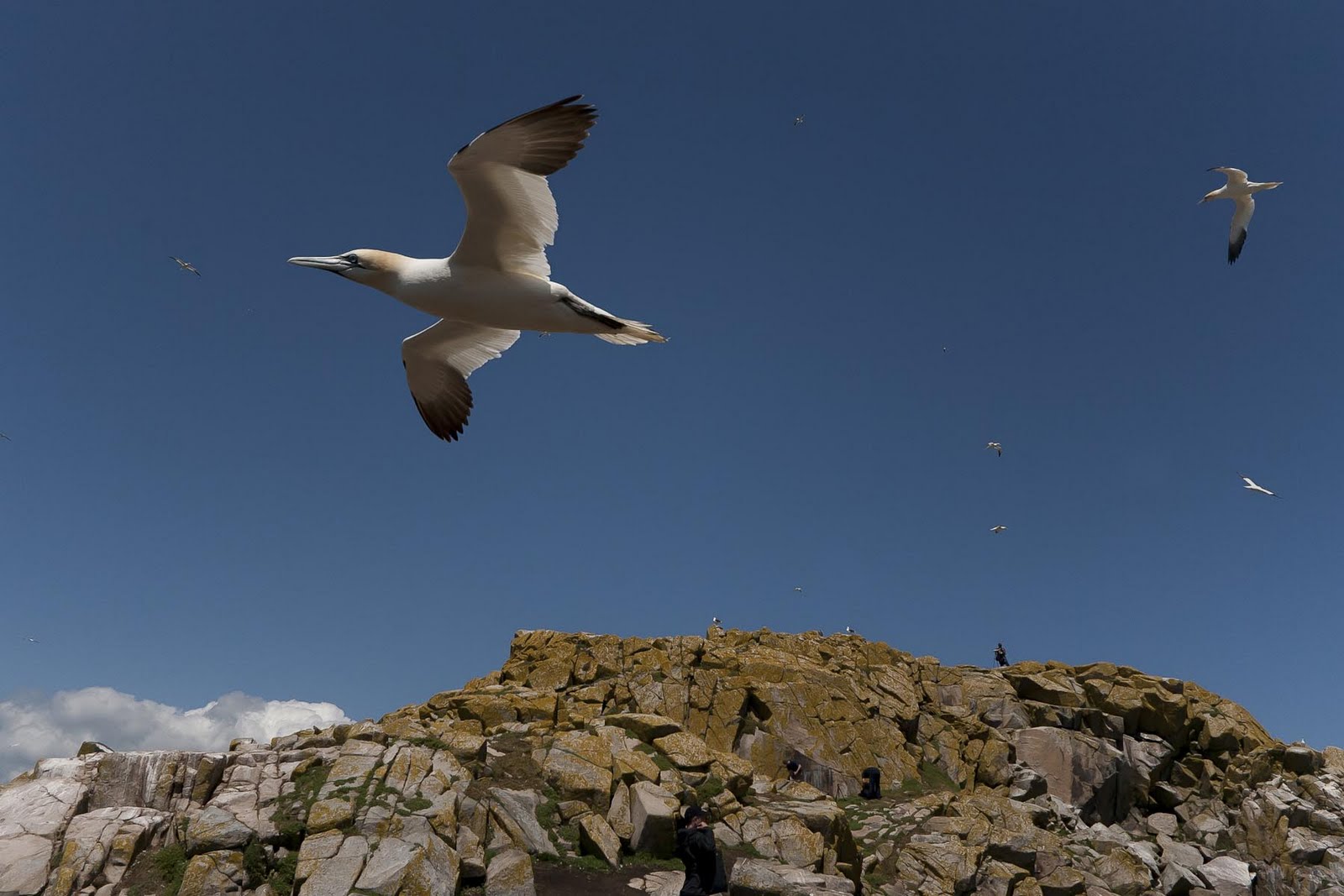
Gannet flying overhead
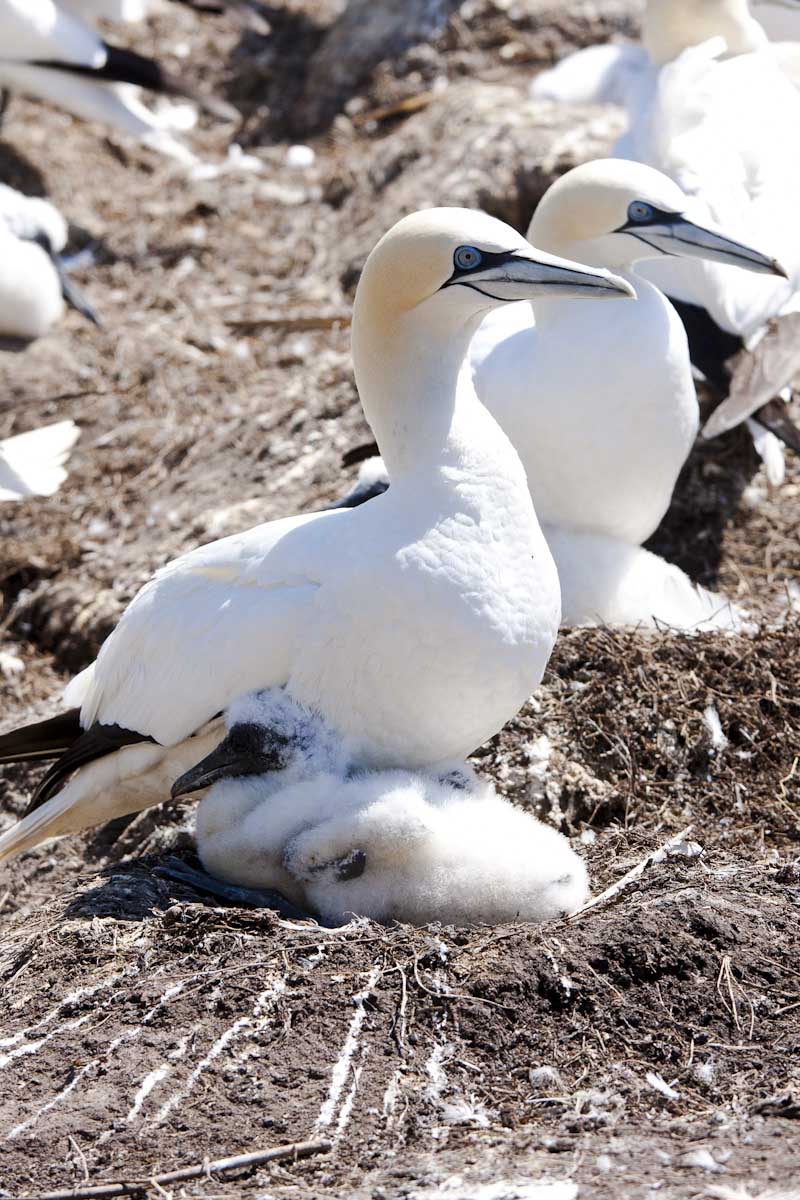
Gannets and Chick
Gannet Chick
Flying close by
Wide Angle Gannet Fly by
Gannet on a Rock
Gannet at 170mm
Gannet Flying into the Sun
When I felt I was done with photographing Gannets I slipped down the back of the Island to photograph some of the Razorbills congregating below the Gannet Colony. First of all there were this loving couple. Then I tried some flight shots before ending up with a portrait.
Razorbill Couple Preening
Razorbill coming into land
Razorbill coming into land
Portrait of a Razorbill
Time had gone fast and with only 45 mins until the ferry came to pick us up we headed to the other end of the island where we met a photographer who said there was a Peregrine just over the hill. No sooner had we crested the hill an adult was calling close by and the reason was fairly obvious a young Peregrine was fifty yards below us.
Young Peregrine on Saltee
Adult Peregrine on Saltee
So we made our way back to the boat and as we were going three Painted Lady's, my first of the year, fluttered around us. At the same time some Herring Gulls were right next to us and I got this portrait.
Painted Lady Butterfly
Herring Gull Portrait
As we made our way back down the hill to the boat a Rock Pipit popped up on some ferns.
Rock Pipit on Ferns
This was the view of the house as we made our way down the hill. What a fabulous Island and one of the best five and a half hours I have spent in my life. I can't wait to go back. The only drawback I got really sunburnt.
Neales House Saltee Island
We got to the shore and were ferried out to the waiting boat on our journey back to the mainland. On the way there were a few Manx Shearwater flying by the boat.
Rib ferrying passengers from Saltee Island to boat.
On friday a fox was seen going under the Tern Island in front of the main viewing hide and then coming up through a hole onto the main platform of the island. So little hope for the eggs or chicks that were on the island.
The Tern Island has obviously been allowed to get into this parlous state and it just seems to me they couldn't care less any more.
When is the RSPB in Northern Ireland going to understand that the "P" in RSPB stands for "Protection".
That is the "Protection" of birds not foxes.
It is high time Mike Clarke the boss of the RSPB and James Robinson RSPBNI Director sorted out these problems.
I love my House Martins and last year by the beginning of June I was wondering whether the pair that breed on the house were going to return. They did eventually return and only had one brood. This year they arrived back at the house on the 7th April.
House Martin returning to its Nest
In recent days I was quite surprised as it appeared that there were often three to four adult birds leaving the nest at one time. On closer examination it turned out that one pair was building a nest adjoining the nest already there.
House Martin Nest Building
Meanwhile at the same time on a gable on opposite side of the house another pair has been building a new nest.
The first few days of the new build seem to be a rather slow process as they wait for the first bits of mud to dry to the wall but as the days go on the process seems to speed up considerably. The farmyard of my neighbour seems to provide them with all the material.
House Martin with Building Material
House Martin's resting on their new build
House Martin with Mud
Carefully Placing Mud onto Nest
Proud of Her Nest Building
Yesterday afternoon a father of one of my sons friends knocked on the door to give me a dead Swallow as he thought I would be interested. It was an adult male with long streamers but most interestingly of all was that it was ringed in Italy. So I sent the details to the Istituto Nazionale per la Fauna Selvatica where ringing recoveries are recorded and await news of when and where it was ringed. Swallows don't weigh very much it weighed 15 grams.
Last week I arranged by means of Twitter to meet Rónán McLaughlin, an excellent Bird Photographer originally from Co.Donegal now living in Co.Cork, at the Magheraroarty ferry for a day trip to Tory Island off the northwest coast of Co.Donegal. We were hoping to photograph some Corncrakes. My inspiration to come and photograph these birds was the above photograph taken by Anthony McGeehan on Rathlin last year and the photograph below taken on Inishbofin a couple of years ago. The top photo being simply superb.
Corncrake on Inishbofin
So on monday morning he set off from Cork at 4.30 in the morning and I set off at 6.30 and we met at 11.30 at the ferry at Magheraroarty.
The weather was fairly dreary and grey. Not good bird photography light. On the ferry trip over to Tory Island we saw Great Northern Diver in summer plumage, Shags, Cormorants, a fair few Manx Shearwater, a single Puffin, Gannets and a single Storm Petrel.
Storm Petrel
Manx Shearwater
Great Northern Diver
Tory Island is situated on the north west corner of Ireland it is about ten miles from the mainland and the crossing can be fairly hairy with atlantic ocean swells that have come all the way unbroken from America. Fortunately for a person who suffers from seasickness this trip was ok. Rónán, however is in the Irish Navy so not a problem for him.
We arrived and were welcomed by the "King of Tory" Patsy Dan Rogers and Rónán had a little chat to him in Irish of which I didn't understand a word apart from traon the gaelic for corncrake. No sooner than we had left him on the pier we heard a Corncrake in the fields behind the main street. Infact there were two or three birds calling. Now we had to find them. We walked up the street and came across another bird photographer who had seen them earlier. From his accent we guessed he came from Dublin. There was a bird calling only a few yards away behind a wall in a field of nettles but could we see it. No. So we decided to head out towards the lighthouse.
Tory Lighthouse
The cacophony of sound from birds on the way there was deafening. There were Lapwing protecting there young from Lesser Black-backed Gulls. Oystercatchers protecting their nests, Common Gulls protecting their young and both Ronan and I were mobbed by one particular individual. Ringed Plover were doing broken wing displays. All in all it was absolutely wonderful.
Common Gull on the Attack
We walked right round the lighthouse and came across this family party of Choughs feeding on the short grass just in front of the lighthouse before they took off at our arrival. Then we both photographed this Common Gull that allowed us to get quite close.
Choughs
Common Gull
After walking right round the lighthouse compound we decided to head towards a lake close to the Lighthouse to see if there were any Little Terns about. As we were doing so we walked through a stretch of boggy land and this bird got up and flew into the wind about forty metres before flopping down again. It was bigger than a snipe and flew low not much more than a metre of the ground in a much less frenetic way than a snipe. It also appeared to land rather suddenly as though it had just stalled and put its wings out at the last moment. Rónán commented afterwards that it was almost lazy in flight. We both said to each other almost simultaneously that it was a Great Snipe even though neither of us had seen one. Apart from the size difference it appeared to have far more white in the tail than a snipe. We decided we had to get photos and headed down towards where it had landed. As we were doing so a number of Dunlin flew around us. We also flushed two snipe both of which flew straight into the wind before heading skywards and over towards the east of the island. These were definitely not the same species in our minds to the bird we had just flushed. Rónán also commented that it was almost Woodcock in size. After searching in the area we thought it had landed we couldn't find it. Then a Dunlin presented us with a nice opportunity so we took a few shots.
Dunlin
I then said to Rónán that we had to go back over the ground we had just come and see if we could find it again. Fortunately for us the bird hadn't moved too far from where we reckoned it had landed and yet again it took off similarly to when we originally flushed it and I got the following poor shots. Yet again it flew only a few metres off the ground and headed away from us before flying to our right and behind a hillock. The tail was again noticeably white. I am positive it was a Great Snipe.
Great Snipe?? 1st Shot
Great Snipe 2nd Shot and Crop
I used to rough shoot and have seen hundreds of snipe over the years and this in my mind and Rónán's was definitely not a Gallinago gallinago. I have also taken photos of snipe in flight before and apart from the obvious difference in size I cannot for the life of me see how the tail feathers of the above bird is similar to the one below.
Snipe in Flight
We searched for quite a bit longer but didn't find the bird again. The ferry that was due to leave at 6.00pm we had been told was leaving at 4.00pm so this curtailed our visit and we headed back to the ferry past a calling Corncrake. The light was now getting worse and the chances of getting a last minute photograph were doomed. On the boat journey back to the mainland a Great Northern Diver appeared even closer to the boat.
It was a long day and even though the light was not in our favour and we did not get to see any Corncrakes but did hear 5-6 birds. It was an exciting one never the less with a possible sighting of a Great Snipe. We will be making a submission to the Irish Rare Bird Committee at some point. Thanks to Rόnán for a great day.