11 Sept 2006

One Curlew Sandpiper less, An Arctic Skua or four and dipped on the Lesser Yellowlegs again

152. Arctic Skua

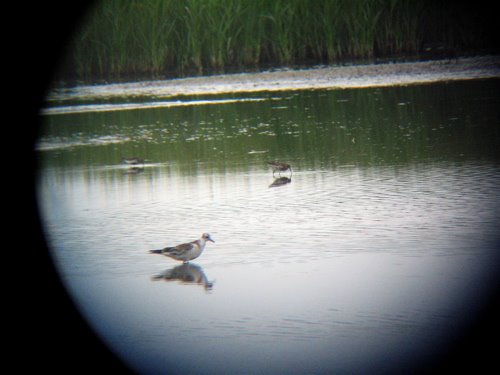
I do bakers hours starting at 3.30am so when I finished at 10.30am I headed off to the reserve to see if the Curlew Sandpipers were still there. It only takes me six minutes to get there from work pretty convenient really. The main hide is closed on a monday so I used the roadside hide sitting there with scope and cappucino which I had brought with me! There were three CS in the middle of the lagoon with a number of Redshank and Black Tailed Godwit. As I was watching them fairly intently through the scope BANG a peregrine picked one of them up and then shot up high in the sky before disappearing towards the airport. I found it quite shocking really as I hadnt been expecting it at all. This particular peregrine is being quite a nuisance at the lagoon at the moment and was the second time I had seen it take a small wader in the last few days.

After leaving the lagoon I heaaded about a mile round the corner to Kinnegar Shore (Click on Image for bigger view) a small shingle and shell beach with a small freshwater outlet that seems to attract hundreds of oystercatchers, gulls, terns and small waders. Derek Charles had spotted Arctic Skuas out across Belfast Lough the day before so I thought I would try and see if I could.I looked for ages without seeing much more than fifty or so eider sitting on the water and the odd gull. Then one of the seacats that go backwards and forwards between Belfast and Scotland was making its way towards the harbour and following it were quite a few terns. Then I noticed four Arctic Skuas chasing one unfortunate tern one of them was in pale phase and the others were in dark phase. They look like mini pterodactyls from a distance. Photo by Derek Charles from the same spot as I was. Another for the list.

After I left there I thought I would head down to Dundrum to look for the Lesser Yellowlegs but even though I searched for over an hour I failed to see it :-(

10 Sept 2006

Five Curlew Sandpiper and a new bird for my list a Merlin


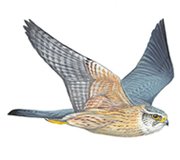
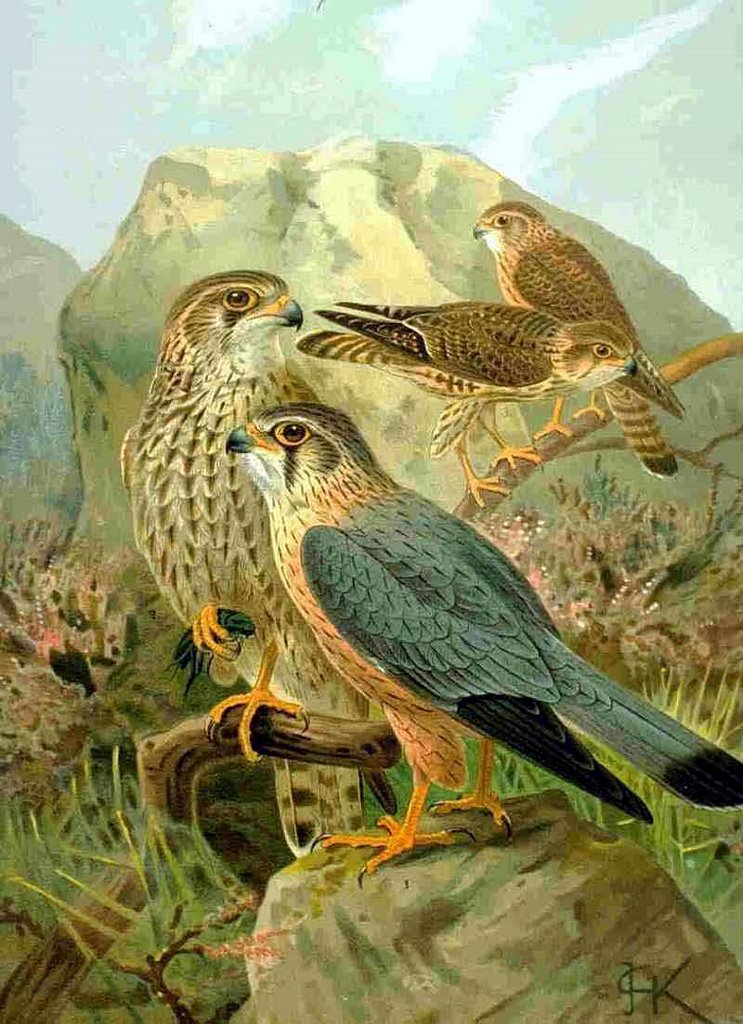
151.Merlin

I was on duty at the Rspb Hide on Belfast Harbour today. Not long after I opened up the two Ian's and Philip West arrived. They are known as "The Leica Boys"" or so I am told. Philip very quickly spotted a Curlew Sandpiper on the far shore and soon after I noticed a wader in front of the roadside hide which I couldnt identify from the way it was positioned. Fortunately three much more experienced eyes confirmed it was another Curlew Sandpiper and then another just behind it. They then disappeared down to the roadside hide. I had quite a few visitors at the time and was pointing the birds out when I realised there were four of them and one on the far shore so five Curlew Sandpiper in all.

Phil came back and suggested I try and get some photos and as there was another volunteer visiting he held the fort while I went and got a few shots of them. My unrepaired camera has a exposure problem and it massively overexposes so was experimenting with it to see if I could get a half way decent image.

Otherwise the afternoon was pretty uneventful not even a visit from the peregrine that is terrorising the site at the moment.

On my way home I decided to have a quick look at the Quoile Pondage. I was driving down to the hide on a single track road when I had to pull in to let a car get past. At that moment an adult male merlin suddenly popped over the hedge and was flying low alongside the car coming towards me. I thought it was going to go under my car when it just appeared in front of me flying up over the car. I couldnt have been more than two feet from it. It made my day as it was my next tick for my list.

The Merlin (Falco columbarius) is a falcon that breeds in northern North America, Europe and Asia.
In North America it was once known as the pigeon hawk, and its scientific name (from Latin columba, a dove) also refers to this popular prey item. However, the Merlin is a falcon, not a hawk, so the old American name is to be avoided.
This small bird of prey breeds in open country such as moorland, taiga or willow or birch scrub. Like the larger Peregrine Falcon, it is migratory, wintering in more temperate regions. Northern European birds move to southern Europe and North Africa, and North American populations to the southern USA and northern South America. In winter, the Merlin may be found in almost any open country, from coasts to prairies to desert scrub. In the mildest parts of its breeding range, such as Great Britain, it will desert higher ground and move to coasts and lowland.
In Europe, Merlins will roost communally in winter, often with Hen Harriers. In North America, communal roosting is rare, and Merlins are well known for attacking any birds of prey that they encounter, even eagles.
The male Merlin has a blue-grey back and orange-tinted underparts. The female and immature are dark brown above and whitish spotted with brown below. American subspecies range from pale (Great Plains) to nearly black (Pacific Northwest). This species' small size, darker underparts, and less strongly marked face distinguish it from the Peregrine Falcon.

Merlins rely on speed and agility to hunt their prey, which is mainly small birds such as larks and pipits and also large insects. They often hunt by flying fast and low, typically less than 1 metre above the ground, trying to take prey by surprise.
Merlins nest on the ground in most of their range. In the UK this is usually in a shallow scrape on heather moorland. They have a preference for long heather so are suseptible to over management, by burning.
In medieval Europe, Merlins were popular in falconry.

3 Sept 2006

I am trying to see this Lesser Yellowlegs that has been around for a couple of weeks.

No new birds for list.

I was woken by a text message saying the Lesser Yellowlegs was still at Dundrum Bay south. So grabbed my low calorie breakfast of 1 banana and headed out. (I have now lost 26 pounds in the last month and had to tighten belt by two notches so diet is working well! I only have another 24 pounds to go which I think will take a bit longer).Click on Image for larger version.

I arrived in Dundrum about 20 mins from the house and started to scan the seashore only to look up about five minutes later to see 6 birders (Gerard McGeehan, Shirley, Norma P-P and Carol UOH and two other guys whose names I have forgotten)on the other side of the road looking at something. Locked car and dashed across very busy road to the other side. It wasnt the Lesser Yellowlegs (Photo courtesy of Derek Charles who had texted me earlier) it was a lovely juvenile Spotted Redshank. It was fishing with its head completely under the water. It then flew over to main bay. I watched it for a little longer before I had to head off to Belfast as I was on duty again at the RSPB hide. Again I dipped on the Lesser Yellowlegs

When I got there there was virtually no birds on the reserve. A few blacktailed Godwit, A single Knot, a few Redshank, Shelduck, Teal, Mallard and a Widgeon and two Dunlin. Unfortunately I couldnt find the juvenile Curlew Sandpiper that had been spotted over the last few days. and photographed by Derek.

The excitement for the afternoon was a Peregrine catching a Godwit and a Buzzard caught a rabbit, which it proceeded to devour. There were four magpies very warily trying to get titbits with one of the birds grabbing at the buzzards tail. It didnt seem that bothered by them. This hide dishes out all sorts of excitement.

I really like volunteering at the hide you meet all sorts of people. The last couple of weeks I have had a guy called Damien in the hide and he is obviously fascinated by raptors. He goes and sees them in Sicily and soon going to Falsterbo in Sweden, which is reknown for being a migration hotspot. There was also a boy of about 11-12 years old who came in who was definately a birder of the future. He was really excited when I showed him the Knot as he hadnt seen one before.He then proceeded to tell me about his trip to California in the summer and the different birds he had seen. I asked him if he had seen any Hummingbirds as it was the one bird I remember seeing in LA twenty years ago. He then said he had seen Rufous and Anna,s which surprised me. He then asked me if I wanted to see his sticklebacks which slightly concerned me as I didnt want to leave the hide. So he rushed off and brought them back in and told me that they were two different species the Three Spined Stickleback and the Nine spined Stickleback.He was showing them to everybody in the hide. Not once did his parents come into the hide from their car! I subsequently found out that he is known at the other RSPB Reserve at Portmore Lough and nicknamed "The Professor" !!! He even found a Cattle Egret near Lough Neagh recently.

26 Aug 2006

Osprey again!

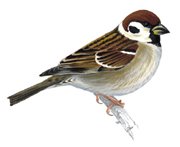
150. Tree Sparrow

I was on my way home from Belfast and stopped in the Quoile Hide at Collectors Bay this afternoon and there were hundreds of Mallard and little else. Then there seemed to be an uneasiness with the ducks and my first thought was there must be a Peregrine around but no there was a juvenile Osprey. I was well chuffed seeing my second osprey within a week and sixty miles apart, especially as I have not seen any in Ireland before last weekend.

This Osprey then dived at a fish twenty yards in front of the hide unsuccessfully, but what a sight. As it was rising some mallard and Teal flew off and out of the corner of my eye I saw a Peregrine stoop at one of the Teal missing it by millimetres. The Teal then landed a foot away from some rushes which it hastily made for. The peregrine then climbed higher and higher in the sky before yet again diving down at a pigeon which it also missed. This year I have watched probably ten attempts by a Peregrine to catch its prey and only twice have they been successful. Well needless to say after watching the Peregrine I lost sight of the Osprey also typically my camera is at menders so no photos.

Yesterday evening I was walking from my sitting room into Kitchen and glanced out of the window and there were four Spotted Flycatchers sitting on the garden wall flying off to catch insects and then flying back again. I assume they must have been this years juveniles. Another tick for the house list. They were then joined by a juvenile Robin and a Wren so a good evening it was. I wonder whether the Flycatchers had been nesting nearby. I hope so. I am now off to Killard with the dog as she hasnt been out alot recently due to being on heat. I bumped into a very old priest who walks out there quite regularly and he asked me the other day where she was and I told him. His response was " I am glad you are keeping her away from temptation"!!

Returned from walk with another tick for the year aTree Sparrow in a hedgerow which is on the whole very good for birds. There were Whitethroat, Greenfinch, Goldfinch and Tree Sparrow. The Tree Sparrow is on the Red List that is to say it is

Globally threatened
Historical population decline in UK during 1800-1995
Rapid (> or =50%) decline in UK breeding population over last 25 years
Rapid (> or =50%) contraction of UK breeding range over last 25 years

So now I have reached 150 I need to get to 160 which was my target for the year. While I was on my walk I also saw for the first time in Northern Ireland a Clouded Yellow Butterfly

20 Aug 2006

Three new birds to my List. Two of them lifers. Crane, Osprey and Pectoral Sandpiper.

147. Pectoral Sandpiper
148. Osprey
149. Crane


WOW what a day. It was a nice morning and I went down to the Blackstaff River which runs into Dundrum Bay as a Lesser Yellowlegs had been seen earlier in the week. (I went down twice earlier in the week to no avail) The tide was pretty high and the only birds around were about nine roosting Greenshank and a few Redshank. I walked up the river and suddenly sighted a Kingfisher flying away from me. I edged closer and got it in my scope only to notice there was another just behind it. They do have to be one of the UK's prettiest birds. This is the second time in the last ten days that I have seen a Kingfisher the other I watched for about fifteen minutes fishing up in Belfast on the Whitehouse Lagoon.

I then went home and had lunch ( Very little lunch as I am on a diet for about the first time in my life. I got on the scales a few weeks ago and was just shy of eighteen stone. I am already down to sixteen and a half. I hope to get down to about fifteen over the next few months. I find dieting very similar to giving up cigarettes which I did about nine years ago. I have had sugar in my coffee and tea all my life and for the last three weeks none at all amazingly I dont really miss it. It seems to be habit more than anything else. No cheese, No chocolate, No Snacks between meals unless its fruit are my other rules. I hope it works.

My phone beeped and there was a text to say there was a Juvenile Pectoral Sandpiper had been seen at the reserve in Belfast. an American wader. Into the car I got and headed the thirty miles to Belfast, my nails being chewed in anticipation. (My next task after the diet stop chewing my fingernails!) The last two occasions I have gone specifically to see a bird I had dipped so this time was pleased that it was not far from the front of the hide. Derek Charles pointed it out to me it was a wee bit bigger than a Dunlin and had a certain resemblance to me off a ruff. ( Infact while my camera is at the menders all the photos that I post have been taken by him unless otherwise mentioned).
There was also a Green Sandpiper along the shoreline of the lagoon. I then went and saw Anthony McGeehan who was photographing with Ivan at another hide on the lagoon.Anthony told me how the pec's migrate and that some come down through Uk and on to South Africa whereas they would normally migrate to South America.

I had arranged for Derek Charles to show me how to get toLough Beg where he had seen a pair of Cranes and a pair of Ospreys over the summer. I met him at a gas station outside Toome and then we drove the five miles to a spot where we could observe the lough. We set up our scopes and there sat on a post was an Osprey. Absolutely brilliant I have seen them in Scotland and also on Marthas Vineyard where I lived for about five years in the eighties. It then lifted off the post and started ot fly over the lough hovering very similarly to a Kestrel before diving down attempting to catch fish. This happenned three times before he caught one which he then flew back to his post and proceeded to eat. It was a real case of being eaten alive as the fish was wriggling for a long time.

Then Anthony's brother and friend turned up. Suddenly they shouted the Cranes are coming in and they were; very majestic birds they are too. What a day.

Now my only downer for the day is that September 1st is approaching. Its the start of the duck shooting season and this lough is renown for the duck shooting. Only in Northern Ireland would they allow shooting on a Lough where two very rare birds live. I am sure both the cranes and the ospreys will leave as soon as the shooting season starts. :-( Why our very ineffective Dept of Environment wont do anything I do not know.

13 Aug 2006

A Spotted Redshank and some great views of Reed Warblers

145. Spotted Redshank
146. Mediterranean Gull


Today I added two more to my year list. I am really looking forward to getting to 150 and even better my target of 160 for the year. I was on duty again at the RSPB Hide on Belfast Harbour. It is a great spot considering it covers about 25 acres. It has a list that is approaching two hundred different species of birds in the last ten years. For example this year we have had seven different types of tern visiting Arctic, Common, Roseate, Sandwich, Forster's, Little, White winged Black tern. Well I personally havent :-(

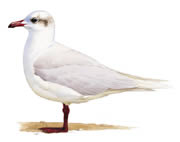
Today I was looking out of the hide at a little shingle bank thirty yards from the hide and I said to Anthony that the Redshank looked a little odd and he looked and said yes a Juvenile Spotted Redshank, I raced out side and told four birders who had just left, who gratefully returned to have a look. This bird had been seen the previous day by Derek Charles and when he came in he pointed out a Mediterranean Gull to me. Gull identification is not easy for me I suppose the more I look at them the more likely to notice the differences between say Med Gull and Black Headed Gull. I have a very good reference book on gulls Which I read when I can.

Last week Anthony cut a path through the reeds outside the hide which made it alot easier to see the family of Reed Warblers, infact I had four in view in the scope and there were a few sedge warblers around as well.

8 Aug 2006

A Yellowhammer but no Franklin's Gull and other birding news from the last few weeks.

144. Yellowhammer

(You may or may not notice this is the same number as before. Somebody pointed out that I had linnet on my list twice.


Finally I have seen a Yellowhammer. I have never seen one in Northern Ireland. I have been asking over the last couple of months where I might find them and have been out specifically looking for them. I was told below Scrabo Tower I might find them and nearer to home I was told of a few places. So on my way home from work (of course via the Belfast Hide, which is six minutes from work) I was thinking I must look at all birds on the telephone wires and within thirty seconds of thinking it and about five hundred yards from my friends David and Celia I saw a bird singing from the top of a telegraph pole. I pulled the car over opened the sunroof and bingo there was an adult male yellowhammer singing its heart out.

Three days ago on saturday I received a text from Joe Lamont to say he had found a Franklins Gull at the Whitehouse Lagoon. As it arrived in the evening and I was 30 miles away in Strangford I decided not to bother. As driving to Belfast twice in a day can be tiresome and not to mention the cost of petrol nowadays. Anyway I was on duty at the RSPB hide on Sunday afternoon and during which time I heard that it had been seen again by another birder Phil. So I headed off there after work. I hadnt been there before so took a wee while finding it but the row of birders with scopes alerted me to the fact I must be in the right place. I seem to have a habit of turning up within a few minutes of a rarity flying off and for them not too return.

As I cant upload images at present I will post and add images at a later date.

23 Jul 2006

A Green Sandpiper and witnessing nature at its worst.

144. Green Sandpiper

Sorry I havent been writing for a while. I have found my work is taking up alot of my time, plus wife and children gives me less time to bird. Anyway today I was on duty at the Belfast Harbour Reserve. I got there to find Anthony (the warden) had come back from a week at Cape Clear in Co.Cork The lagoon at the Harbour Reserve had dried up completely after the lack of rain and high temperatures we have been experiencing recently. Anthony is going to try and arrange with the Water Service to pump some water into the lagoon so that the waders continue to visit.

We spotted a lapwing in distress near the hide, in that it couldnt fly and was wobbling about.... botulism maybe. Within a very short period of time a Magpie arrived on the scene and started to peck at its eyes with the lapwing screaming away. The lapwing vainly tried to resist but didnt last long before the magpie had taken its eye and then pierced its brain killing it. Not a pretty sight especially as one couldnt do much about it.

As I was leaving the hide I got a text from Derek Charles that a Green Sandpiper had been seen on the Blackstaff river which runs into Murlough Bay . After finding out exactly where it was I headed down there. When I got there I parked near a bridge over the river and walked down the river, which I assume is tidal at this stage and the tide was well out. I immediately saw three common sandpipers and the Green Sandpiper, which I didnt see on the ground , took off and zig zagged down the river. I memorised its call and it was exactly the same as my guide. I tried to get to it quietly but it was very shy and flew off before I could get a really good view off it. There was also a family of young shelduck and a Greenshank chasing fry in the shallows. I will definately come back to this spot as I hadnt been there before.

8 Jul 2006

My latest for my birdlist 2006

143. Stock Dove

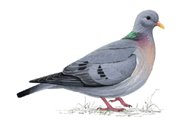
I was on duty at the birdhide on Belfast Harbour Reserve and two woodpigeons landed very close by followed by at first glance another immature woodpigeon, however on closer examination it was a Stock Dove .Stock doves are similar in plumage and size to rock doves/feral pigeons. They are largely blue-grey with an attractive iridescent bottle green band on the back of the neck. In flight they show black edges to the wing and two partial black bands near their back. Unlike rock doves/feral pigeons they do not have pale rumps. They are widely distributed in the UK, except for parts of northern Scotland and Ireland, with particularly high densities in the English Midlands and South West. Over half their European population is found in the UK.

My Birding is going very slowly at the moment as I have set up the kitchen in my new job and I have now started getting up at 3.45am to go to work to make the soup, sandwiches, panini's and Ciabatta's for the seven cafes, soon to be eight. Once the initial problems have been ironed out I should have some more time.

3 Jul 2006

I dipped a Forster's Tern by a minute

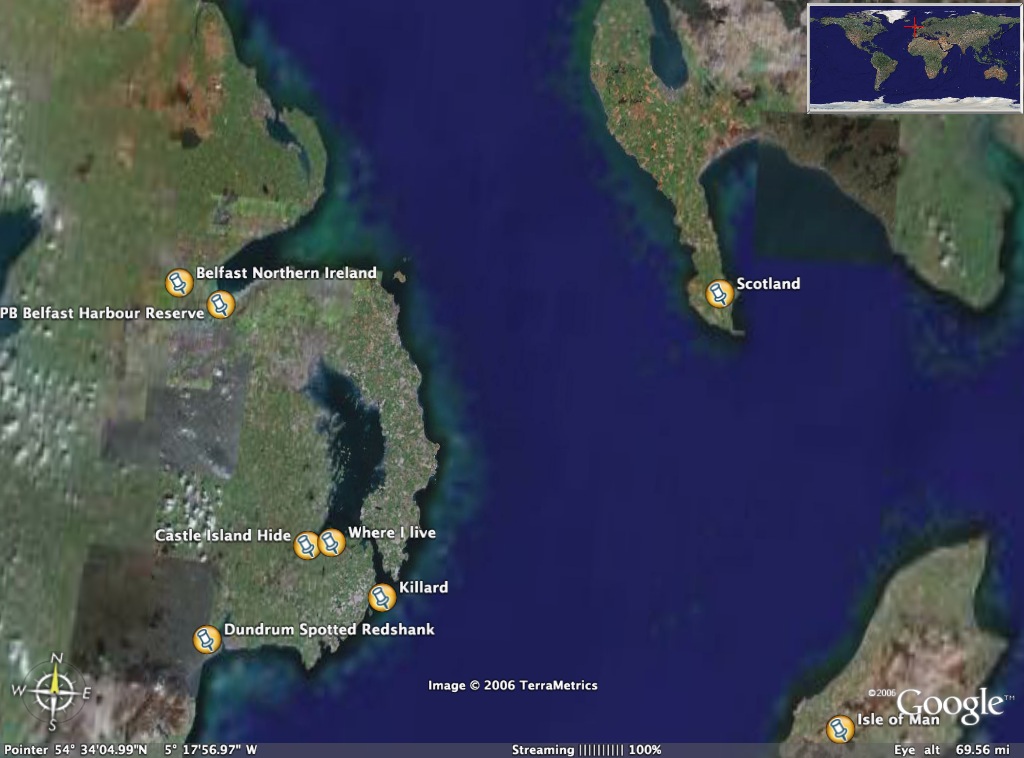
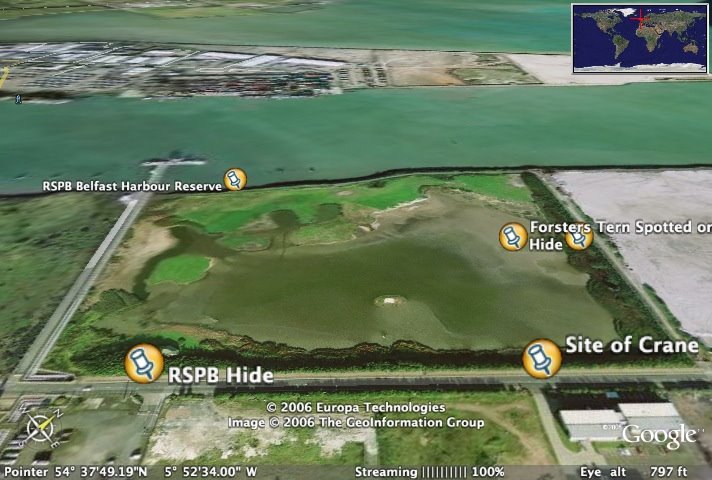
I was on duty at the RSPB Hide on Belfast Harbour Reserve yesterday from 1-5 It was a very bright day but there were alot of birds to be seen. This google image was taken a few years ago as there are now two manmade tern islands in the lagoon.

Common Tern
Arctic Tern
Sandwich Tern
Redshank
Snipe
Knot
Dunlin
Curlew
Curlew Sandpiper
Black Tailed Godwit
Mallard
Shelduck
Heron
Oystercatcher
Little Gull
Herring Gull
Black Headed Gull
Lesser Black Backed Gull
Greater Black Backed Gull
Buzzard
Chaffinch
Greenfinch
Linnet
Reed Bunting
Sedge Warbler
Willow Warbler
Swift
Swallow
House Martin
Sand Martin
Wood Pigeon
Lapwing
Ringed Plover
Coot
Moorhen
Jackdaw
Magpie

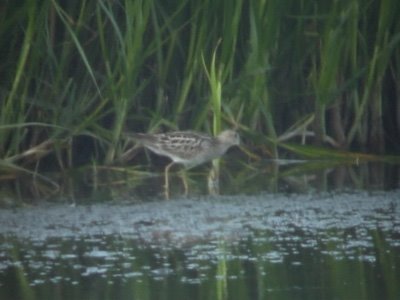
A phonescoped photo of the Curlew sandpiper

At the end of the shift I went up a crane which Anthony (The Reserve Warden) had hired to count the tern nests on the islands without disturbing them and there was a brilliant view of the reserve. I think the RSPB should build a high rise hide! Earlier in the day some Roseate Terns had been spotted and I didnt see them so we then went to Kinnegar Shore less than a mile away to see if we could see any again sadly not. I then had to race to Sainsburys to get buy an organic chicken for supper when I got a call from Anthony to say that there was a Forsters Tern in front of one of the hides. I raced back to the Reserve at high speed and as I was driving up the adjoining track to the hide I was told it flew off. Anthony and his brother and brothers friend saw it less than 30 yards away and he got a good shot of it. It didnt return. A Forsters tern would be a very rare bird for Northern Ireland in that it would have come from America.Within minutes the birding grapevine was working as more and more birders turned up to be dissapointed. I hope it will be seen again I am going to Dentist in the morning and will stop off beforehand at the reserve. Crossing my fingers.